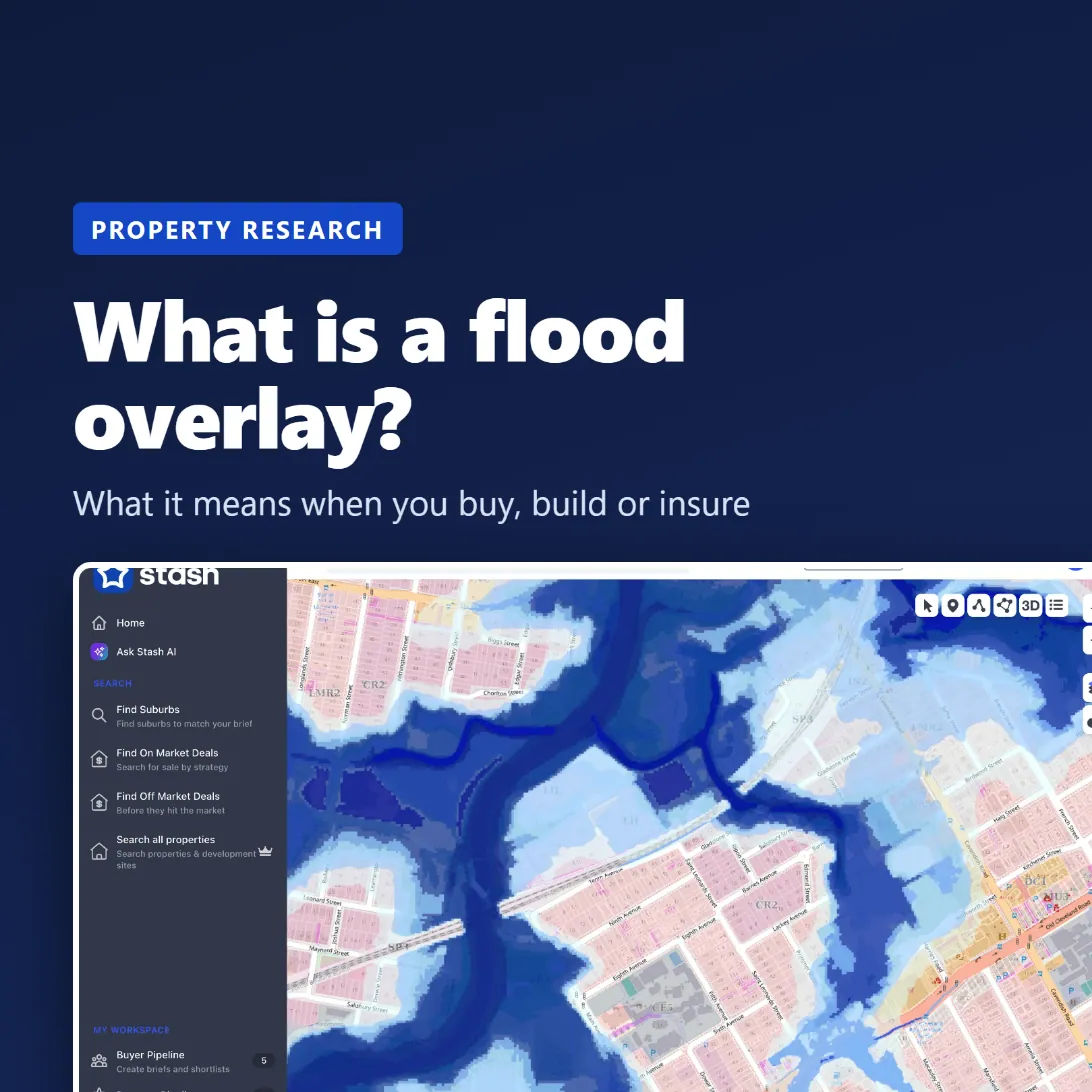

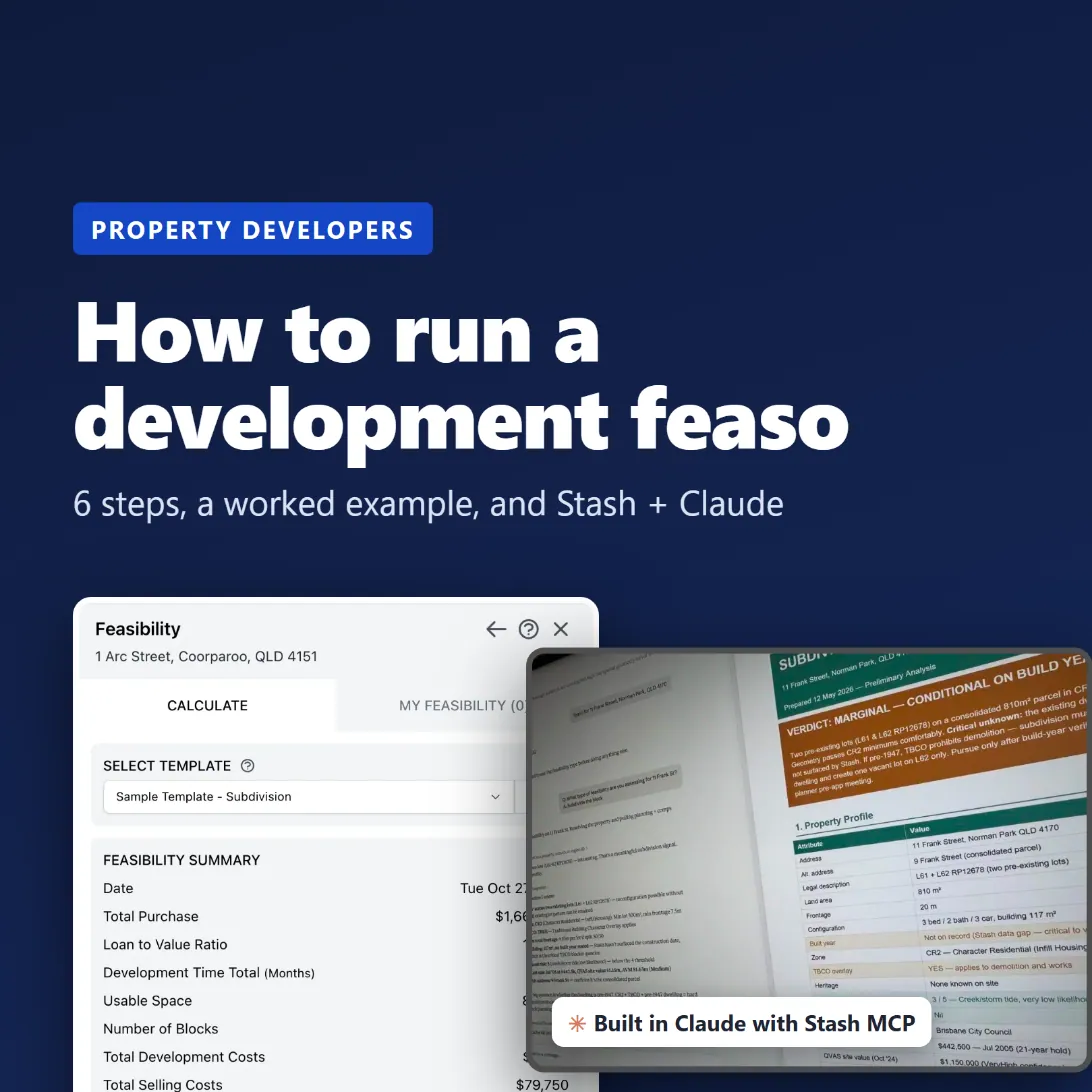
A development feasibility study, or "feaso", answers one question: will this project make enough money to be worth the risk? Run it before you buy the site, not after. This guide walks through the six steps, then works through a simple duplex example.
The basic formula
Every feaso comes back to the same sum:
Profit = Gross Realisation Value (GRV) − Total Development Cost (TDC)
GRV (also called GDV, gross development value) is what you expect to sell the finished product for. TDC is everything it costs to get there, including the land.
Step 1: Confirm what you can build
Start with the planning rules, because they set the size of the opportunity. Check the zone, minimum lot size and frontage, height and site cover limits, and any overlays such as flood, heritage or character. In Stash, the Planning Insights tab shows the zone and, where available, the minimum lot size and frontage for the site. See minimum lot size and zoning details.
Step 2: Estimate the end value (GRV)
Use recent comparable sales of new, similar product nearby, not the established house next door. Two new townhouses will sell differently to an old cottage on the same street. Be conservative: a feaso built on best-case sale prices will always look good on paper. See using comparable sales in your feasibility.
Step 3: Add up every cost (TDC)
A complete cost list usually includes:
- Land: the purchase price
- Acquisition costs: stamp duty, legal fees and due diligence
- Construction: build cost, demolition and site works
- Professional fees: architect, town planner, engineers and surveyor, often around 8–12% of construction
- Statutory costs: council application fees, infrastructure charges and contributions, utility connections
- Contingency: commonly 5–10% of construction
- Finance: interest and loan fees over the life of the project
- Selling costs: agent commission, marketing and legals
- Holding costs: rates, land tax and insurance while you build
The most common mistake is leaving costs out. Don't use $0 for land you already own: use what it's worth today, or the profit is overstated.
Step 4: Calculate the margin
Margin is usually measured in one of two ways:
- Margin on cost (profit on cost) = profit ÷ TDC
- Margin on revenue = profit ÷ GRV
Margin on cost always reads higher than margin on revenue for the same project, so check which one your lender or partner uses. As a rule of thumb, many developers and lenders look for around 15–20% margin on cost, and more for riskier projects. Small, simple projects like a two-lot subdivision are sometimes done on lower margins, but there's less room for error.
Step 5: Work out what you can pay for the land
Run the sum backwards to get the residual land value: the most you can pay for the site and still hit your target margin.
Residual land value = GRV − all non-land costs − target profit
If the asking price is above your residual land value, the deal doesn't stack up at that price. Negotiate, change the product, or walk away.
Step 6: Stress-test it
Change the key inputs one at a time and watch what happens to the margin. A useful set of tests:
- sale prices 5–10% lower
- construction costs 10% higher
- the project taking six months longer (more interest and holding costs)
- interest rates 1% higher
If one of those wipes out the profit, the project carries more risk than the headline margin suggests.
Worked example: a duplex
A buyer is looking at a $900,000 block where they can build a duplex and sell each side for $1.1 million. All figures are illustrative and exclude GST.
- GRV: 2 × $1,100,000 = $2,200,000
- Land: $900,000
- Acquisition costs: $40,000
- Construction: $750,000
- Professional fees (10% of construction): $75,000
- Statutory costs: $30,000
- Contingency (5% of construction): $37,500
- Finance: $80,000
- Selling costs (2.5% of GRV): $55,000
- TDC: $1,967,500
Profit is $2,200,000 − $1,967,500 = $232,500. Margin on cost is $232,500 ÷ $1,967,500 = 11.8%, below a 20% target.
To hit 20% margin on cost, TDC can be no more than $2,200,000 ÷ 1.2 = $1,833,333. Take away the $1,027,500 of non-land costs and that leaves about $805,800 for the land and its acquisition costs, or a purchase price of about $770,000. At $900,000 this deal only works if the buyer accepts a thinner margin, finds a better product, or negotiates the price down.
Run a feaso in Stash
Open the property in Stash, go to the Due Diligence tab and click Create new feasibility in the Feasibility card. Stash fills in the land area for you. Enter the purchase price (or click Calculate median per sqm to estimate it from nearby sales), describe what you plan to build, and work through the finance, selling and development costs. The Feasibility Summary updates as you type, showing total cost, net profit and profit on cost.
You can model more than one design on the same site, save your own templates for a strategy you use often, add comparable sales for the end value, and export the result for your lender or partners. See Run a feasibility study.
Build a feaso with Stash and Claude
If you want a full feasibility report in your own format, with your own assumptions, connect Stash to Claude. Stash MCP gives Claude live Stash data: the property, zoning, overlays, hazards, comparable sales and land values for the site. The Stash Feasibility skill tells Claude how to turn that into a structured feaso.
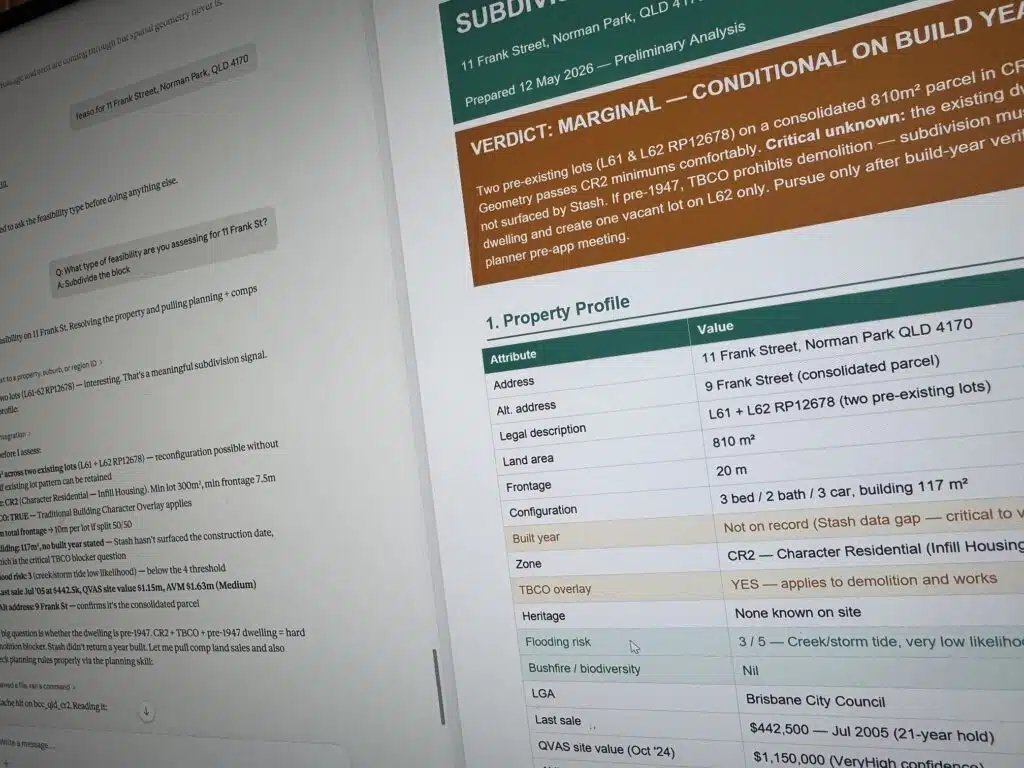
A subdivision feasibility report built in Claude from Stash data. It opens with a verdict, then works through the property profile, planning rules and risks.
- Connect Stash to Claude. Follow Connect Stash to Claude (Stash MCP). You need a paid Claude plan and an active Stash plan with Stash MCP.
- Add the Stash skills. Download the Stash Skills pack and upload it in Claude under Settings → Capabilities → Skills.
- Ask for the feaso. Start a new chat with Stash switched on and ask in plain English, for example: “Can I subdivide 14 Sample Avenue? Give me a feaso.” Claude checks the zoning, lot size, frontage, overlays and recent sales, and tells you if the site looks feasible.
- Change the assumptions. Tell Claude your own build costs, sale prices, margin target or finance terms, and it reruns the numbers. Ask it to stress-test sale prices or costs, or to work out the residual land value.
- Export it. Ask Claude to export the feaso as a PDF or Word file in your brand, or design it in Canva if you've connected Canva.
Use the Stash calculator for a quick check on a site, and Claude when you want a detailed report you can share. See Stash for property developers.
This article is general information only, not financial, tax or planning advice. GST, including whether the margin scheme applies, can have a big effect on a feasibility, so get advice from an accountant for your project.