


Updated November 2026: minimum lot size is no longer a beta feature. We’ve updated the steps to the current Stash app and added where each state sets its minimum lot sizes, including WA’s R-Codes.
What is Minimum Lot Size?
The minimum size of the lot is the smallest size an individual lot can be. This area however cannot be applied to all lots, as developers still need to achieve the average lot size across the entire development.
Not every scheme has an average lot size rule as well as a minimum, so check how your council applies it. In Western Australia, for example, the R-Codes set both a minimum and an average site area for each density code. At R20, single houses and grouped dwellings need a minimum of 350m² and an average of 450m² per dwelling (R-Codes Volume 1, April 2026).
Where minimum lot size is set in each state
- NSW: in each council’s local environmental plan (LEP), through the minimum subdivision lot size clause and its Lot Size Map. Check a property on the NSW Planning Portal spatial viewer.
- Victoria: there’s no state-wide residential minimum. A minimum subdivision area applies only where the zone schedule sets one. See Understanding minimum lot size requirements in Victoria.
- Queensland: in each council’s planning scheme, usually in its subdivision (reconfiguring a lot) code. Brisbane’s minimums changed for some zones in September 2026. See our Queensland town planner interview.
- Western Australia: in the R-Codes, by the density code on the lot (R20, R40 and so on), unless the local planning scheme says otherwise.
How to check Minimum Lot Size?
Are you seeing all the property facts? We first released MLS (Minimum Lot Size) as a beta in 2020. Today it’s part of every property’s planning details:
- Open the property in Stash, by searching for the address or clicking it on the map.
- Go to the Planning Insights tab and find the Planning & Development Potential card.
- Under Lot Requirements, read the Minimum Lot Size, Minimum Frontage, Minimum Rear Lot Size, Average Lot Size and Minimum Multi Lot Size. N/A means the figure isn’t in the planning data for that zone, not that there’s no rule.
- Use the References links to open the planning scheme the figures came from. For the full page, click VIEW PLANNING INFO in the Property Description card on the Property Details tab.
Compare the minimum frontage with the property’s own Frontage too. See Minimum lot size and zoning details and Check street frontage.
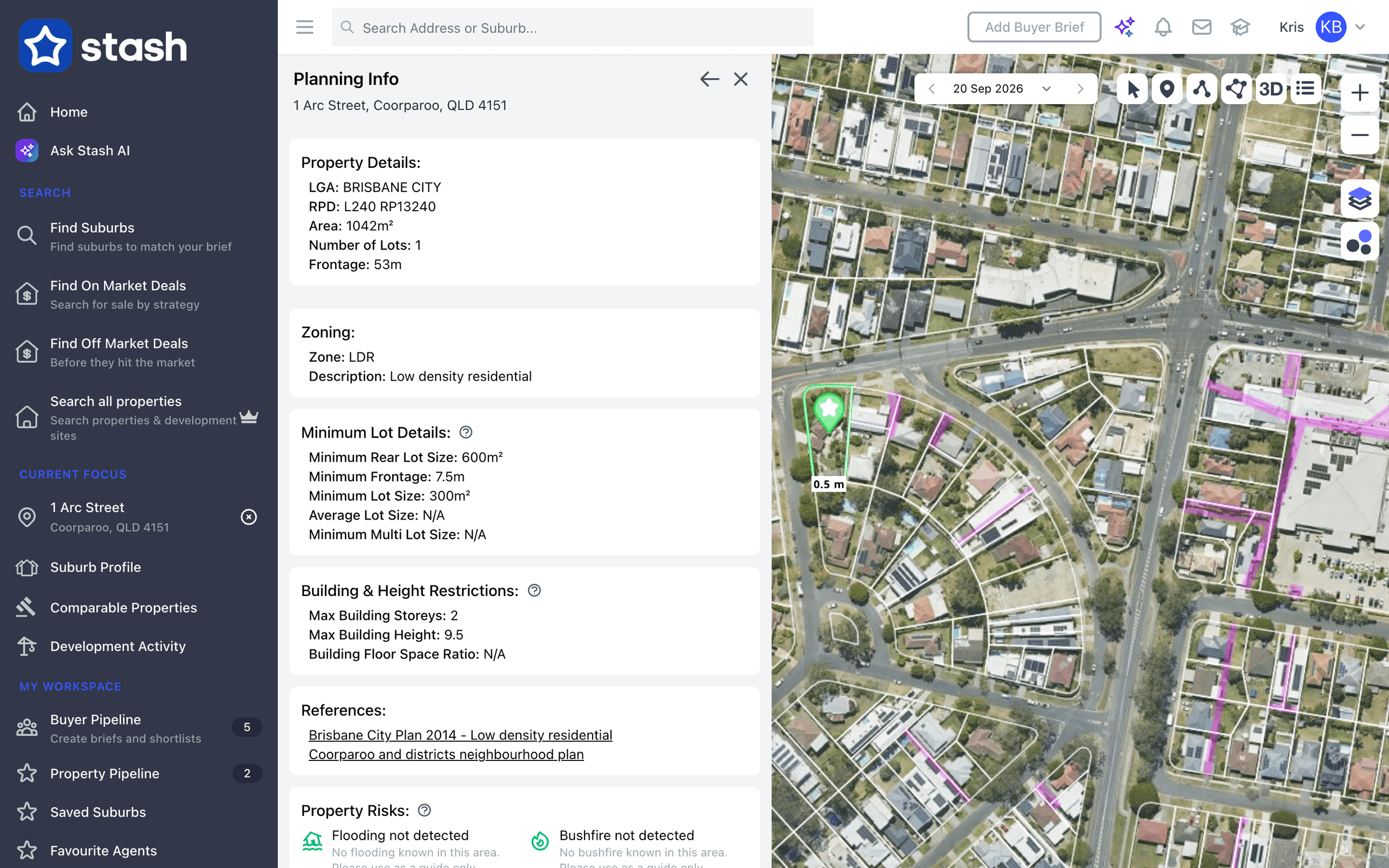
Going beyond the ability to only view the zoning and land size of a property, we moved to surfacing key council information including the minimum lot size.
Depending on the council this information can vary in richness, with the ability to link directly to the references for further understanding of environmental and development requirements.
The screenshots below show how this looked in 2020. In this example we can see the property in NSW displays the Zoning R3 and now with the Lot Size Req Min 900m2. Today the same figure shows as Minimum Lot Size.

In Victoria we can see in the example below with even greater details including the Open Space, Set Back for the Road and Side and Rear, including the link through to council. Today, building controls such as height and floor space ratio show under Building Controls, and the source links under References.

When we link to the reference, we can uncover further information regarding the property and the planning scheme. In this case below is the extract from Whittlesea planning scheme.

While at Stash we continue to add more information at a property level, the importance in being able to research quickly at a local government area (LGA) and dive further in, it’s the importance of also being able to store safely your research with notes that you can easily tag and find.
To find sites big enough to subdivide, use the AREA (m²) and Property Zoning filters in Search all properties. See Find off-market properties.
Minimum lot sizes in Stash are a guide only. Schemes change, and overlays or site conditions can override the base rules, so check the council’s planning scheme and speak to a town planner or licensed surveyor before you buy or subdivide.
Contact the team to find out more about Stash’s features that streamline your property research all in one place.