

Update, 17 November 2026: changes paused
On 16 November, hours before the new rules were due to start, NSW Premier Chris Minns announced the government would pause them. That includes the requirement to show a price or price range, the price floors and the new $110,000 underquoting penalty. The pause could last up to a year, and is expected to be made by regulation rather than by changing the Act. Read the ABC report.
Underquoting is still illegal in NSW, and the existing rules on estimated selling prices still apply. NSW Fair Trading’s pages had not been updated when we wrote this. We’ll update this article when the details are confirmed. The rest of this article describes the changes as originally legislated.
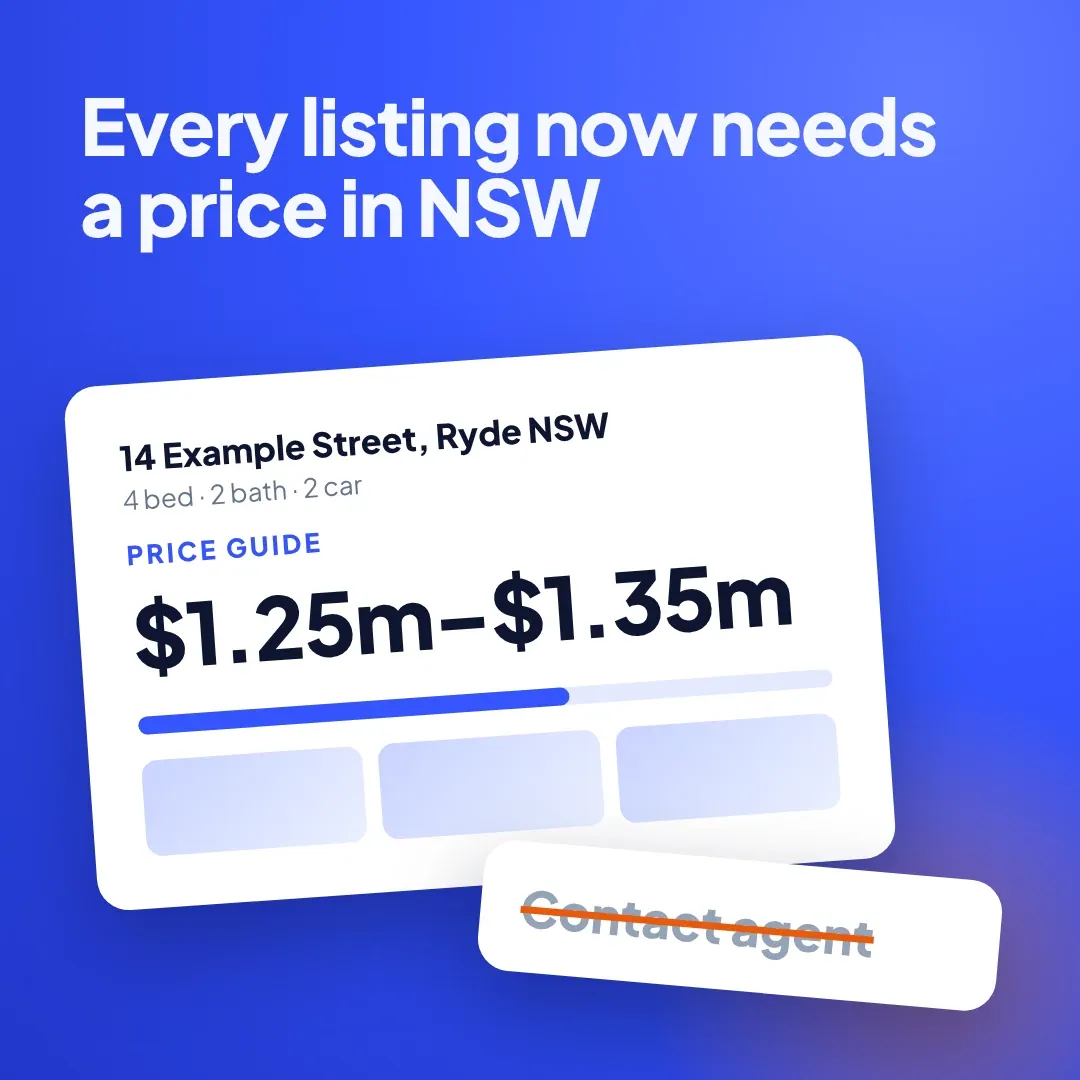
From 17 November 2026, the new NSW underquoting laws require real estate agents to show a selling price or price range on every new residential sale advertisement. “Contact agent” is no longer enough. The price has to be backed by the three most comparable sales, kept above any written offer the seller has already rejected for being too low, and updated online within one business day when it changes.
The changes come from the Property and Stock Agents Amendment (Underquoting and Other Agent Conduct) Act 2026 and its regulation. They are the biggest shake-up of how homes are priced and advertised in NSW in years, and they apply to private treaty and auction campaigns alike.
This guide explains what the law now requires, in plain English:
- what changes on 17 November 2026, and what follows on 8 February 2027
- which advertisements need a price, and which don’t
- how the three comparable sales rule works, including the search radius and time window
- the new price floors for rejected offers and passed-in auctions
- the Statement of Information
- penalties and enforcement
- what it means for sellers, buyers and buyers agents
- how to gather and record comparable sales evidence quickly
It is general information, not legal advice. For the full requirements, see NSW Fair Trading’s guide to the changes.
What is underquoting?
Underquoting is advertising or telling buyers a price that is lower than the agent’s estimated selling price, or lower than a price the seller has already refused. It draws in buyers who can’t afford the property, wastes their time and money on inspections, building reports and loan approvals, and makes it harder to judge what a home is really worth.
In NSW, the agent’s estimated selling price is the agent’s reasonable estimate of the likely selling price. It sits in the agency agreement, and from 17 November 2026 it must be supported by the three most comparable sales.
What changes under the NSW underquoting laws, and when
The reforms arrive in three stages. The first stage, higher penalties and new powers for NSW Fair Trading, has been in force since 29 June 2026. The pricing and advertising rules start on 17 November 2026. The Statement of Information follows on 8 February 2027.
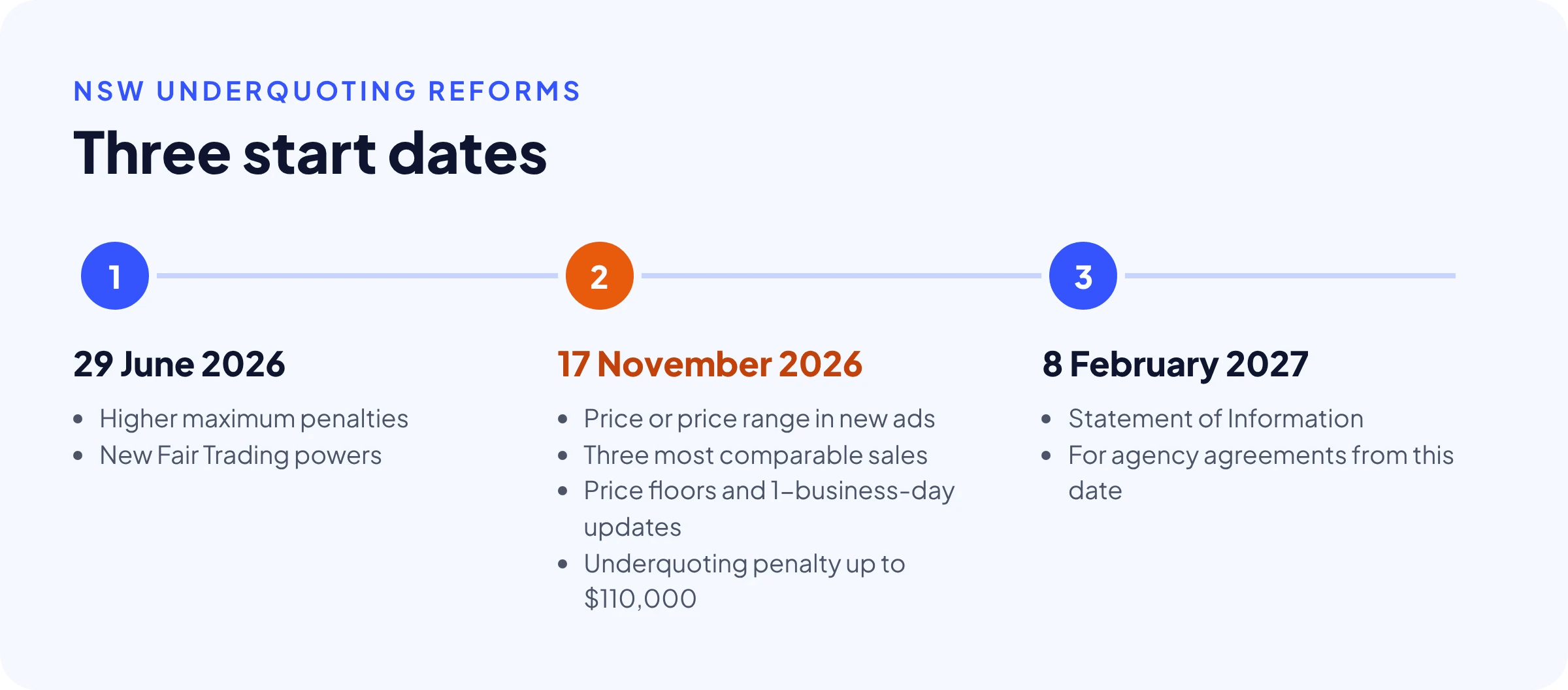
| Requirement | Starts |
|---|---|
| Higher maximum penalties and new Fair Trading powers | 29 June 2026 |
| A selling price or price range in new residential sale ads, including online, social media, apps and email | 17 November 2026 |
| Estimated selling price set using the three most comparable sales, with records kept | 17 November 2026 |
| Price floors: no advertised price below the estimate, a passed-in auction bid or a rejected written offer | 17 November 2026 |
| Online ads that no longer comply updated or removed within one business day | 17 November 2026 |
| New underquoting penalty: up to $110,000 or three times the commission | 17 November 2026 |
| Statement of Information in the approved form | 8 February 2027, for agency agreements entered into after that date |
Every new sale advertisement needs a price
From 17 November 2026, any residential sale advertisement an agent arranges must include a selling price or a price range. That covers the places buyers actually look:
- listings on realestate.com.au, Domain and other portals
- the agency’s own website
- social media posts and paid ads
- apps and email campaigns
- print ads and brochures
It applies to auction campaigns as well as private treaty sales. An auction listing now needs a price guide, not just a date and “Contact agent”. The same goes for “Price on application” and similar wording on new ads.
What doesn’t need a price
- For-sale signboards on or next to the property are exempt. If a sign does show a price, the new rules apply to that price.
- Ads published before 17 November 2026 don’t automatically need a price added. Fair Trading encourages agents to add one. An older ad that shows a price must still be updated or removed if the estimate is revised, the property is passed in at auction, or a written offer is rejected only because it was too low.
Keeping the price current
When an advertised price stops complying, for example after the estimate goes up, online ads must be updated or removed within one business day. Other ads, such as print, must be updated as soon as practicable.
Tip: QR codes on brochures
Fair Trading has said it won’t take compliance action where a brochure carries a QR code that links to the main online ad showing the price, as long as the agent explains how to find it. Its suggested wording is along the lines of “click here to access the advertised price”. It saves reprinting brochures every time the guide moves.
How the three comparable sales rule works
This is the heart of the reform. When an agent sets or revises an estimated selling price, they must consider the sale prices of the three most comparable properties, and the estimate must stay a reasonable estimate of the likely selling price. The regulation sets out where to search and how to choose.
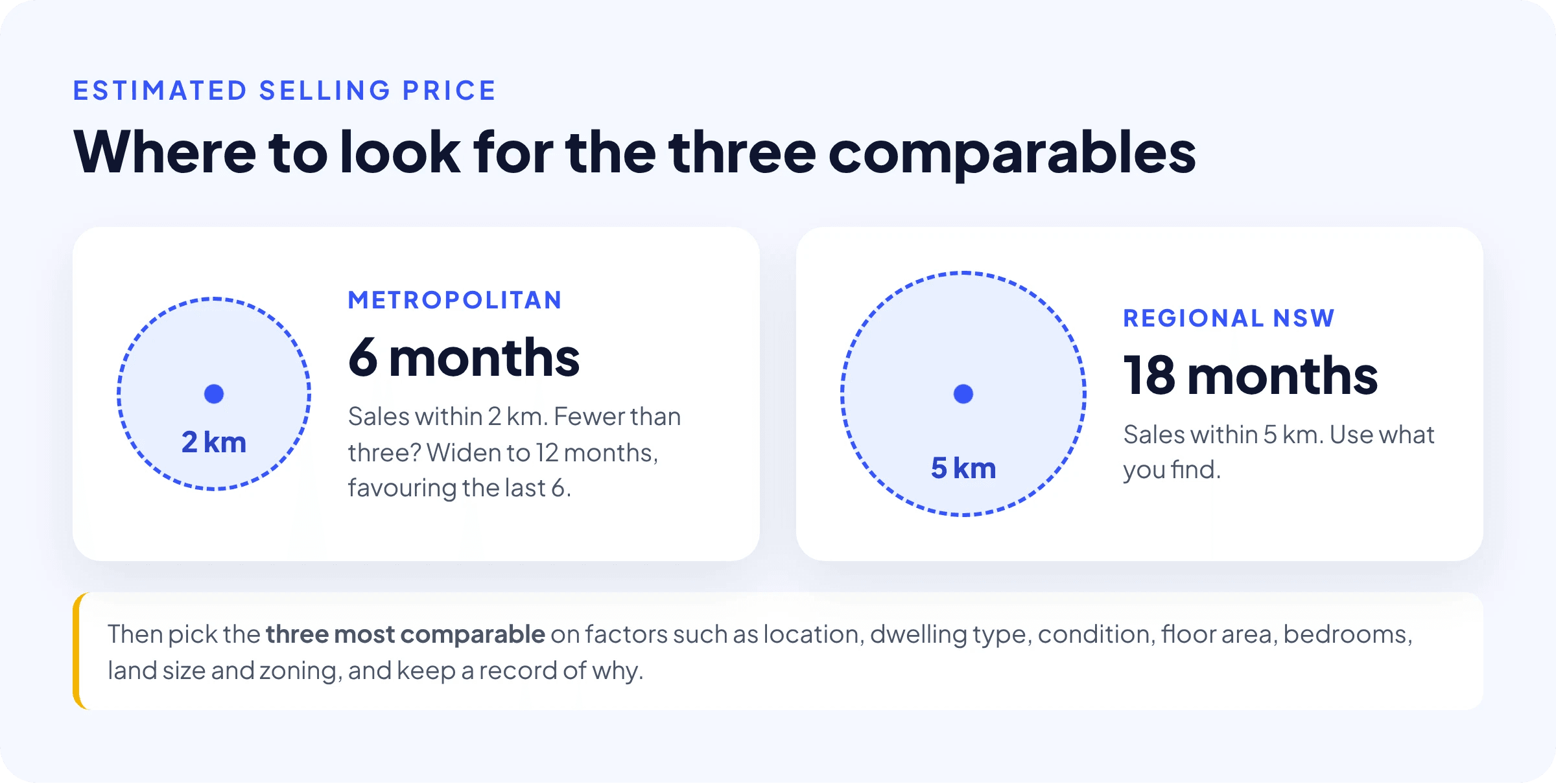
Where to search
- Metropolitan areas (36 listed local government areas): sales within 2 km in the previous 6 months. If the agent reasonably believes there are fewer than three comparable sales, they search again within 2 km over 12 months, treating sales from the last 6 months as more comparable.
- Non-metropolitan areas (the rest of NSW): sales within 5 km in the previous 18 months. There is no second widening step; the agent uses what they find.
Agents must use all the information they hold or can reasonably access. That includes their agency’s own sales records and any non-public databases they subscribe to, not just what appears on the portals.
How to pick the three
The regulation lists factors to weigh when deciding which sales are most comparable. They include:
- date of sale and location
- dwelling type, condition and layout
- floor area, bedrooms, bathrooms and parking
- special features, construction materials, building age and architectural style
- land size, zoning and street frontage
If more than three sales remain after searching, the agent picks the three most comparable on those factors. Where two are almost equally comparable, the more recent sale counts as more comparable.
Setting a compliant price guide in four steps
In practice, every listing now follows the same sequence.
1
Search
Find sales within 2 km over 6 months (metro) or 5 km over 18 months (regional).
2
Choose three
Rank them on the listed factors and keep the three most comparable.
3
Tell the seller
Give the seller the estimate in writing, with the evidence, and record your reasons.
4
Advertise
Show the price or range, and update online ads within one business day if it changes.
The records to keep
Agents must keep records showing how each estimate was reached. Fair Trading’s guidance points to records such as:
- the search carried out and the factors considered
- the addresses, sale dates and prices of the sales looked at
- why the final three were chosen, and the data sources used
- the reasons, if fewer than three comparable sales could be found
- the written notices given to the seller, written offers received, and the evidence behind any revision
Before signing an agency agreement, the agent must give the seller written notice of the estimate, with evidence that it is reasonable. The same applies whenever the estimate is revised. The new estimate, comparable sales, seller notice and record-keeping rules apply to agency agreements signed on or after 17 November 2026, and to earlier agreements once the estimate is revised.
Price floors: rejected offers and passed-in auctions
The new rules also set a floor under the advertised price. The price, or the bottom of a price range, can’t be lower than any of these:
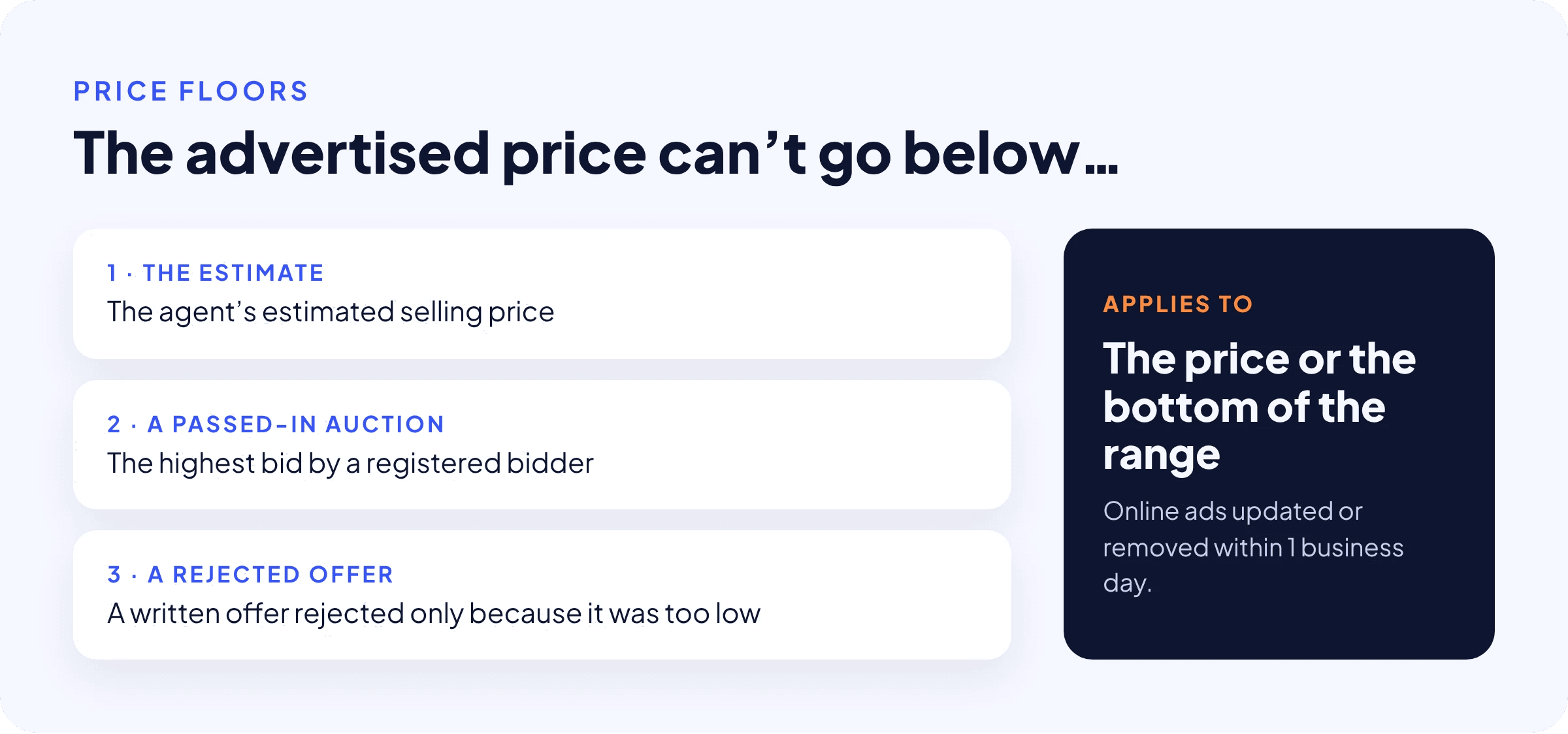
- The agent’s estimated selling price.
- The highest bid by a registered bidder at an auction where the property was passed in.
- A written offer the seller rejected only because it was too low.
For example, if a seller rejects a written offer of $1.18 million purely on price, the campaign can no longer advertise a guide that starts below $1.18 million. If the property is then passed in at auction on a highest registered bid of $1.24 million, the floor moves up to $1.24 million.
The floors apply to campaign pricing, not to bidding on auction day. Industry groups have warned they could make life harder for sellers in a falling market, because a rejected offer can lock in a higher advertised floor even as conditions soften. That is worth discussing with sellers before any offer is turned down.
Insight: the advertised price is still an estimate
A price guide is not a promise. The seller isn’t obliged to accept an offer at the advertised price, and the property can sell above or below it. What the law requires is that the advertised price is a reasonable estimate, supported by evidence, and never below the floors above. Buyers should still do their own research on value.
The Statement of Information from 8 February 2027
The second stage starts on 8 February 2027 and applies to agency agreements entered into after that date. For each residential property, the agent must prepare a Statement of Information in the form approved by Fair Trading. It sets out information about the property and the comparable sales behind the estimate.
The agent must:
- include the Statement of Information, or a link to it, in online ads on websites, social media, apps and email
- display it prominently at inspections
- give a copy within two business days to a buyer who asks for it, or who asks for a copy of the contract
- revise it within two business days if the estimate is revised and the comparable sales change
- keep the original and every revised version for at least three years
Between 17 November 2026 and 7 February 2027, Fair Trading has said it will focus on educating agents about some of the new requirements, while still acting where there is a significant risk of harm to consumers.
Penalties and enforcement
The penalties are designed so that underquoting can no longer be written off as a cost of doing business.
| Breach | Maximum penalty |
|---|---|
| Underquoting (from 17 November 2026) | $110,000 or three times the agent’s commission, whichever is greater (previously $22,000) |
| Fair Trading disciplinary fines (from 17 November 2026) | $27,500 for individuals, $55,000 for corporations |
| Statement of Information (from 8 February 2027) | $27,500 |
| Dummy bidding at auction (from 29 June 2026) | $110,000 for a corporation |
Fair Trading also has new powers. For serious breaches it can require an agent to publicise their misconduct, have their estimates checked by a licensee in charge or an independent valuer, suspend activities, or direct further training.
How the NSW underquoting laws compare with other states
With these changes, NSW joins Victoria in requiring a price on every new listing. Queensland goes the other way for auctions, banning price guides altogether. The other states and territories rely mainly on general rules against misleading prices.
| State | Price required in ads? | Price format | Comparable sales | Auctions |
|---|---|---|---|---|
| NSW | Yes, on new ads from 17 Nov 2026 | Price or range, with no “+” or “offers over” | Three most comparable sales behind the estimate; Statement of Information from 8 Feb 2027 | Need a price guide; a passed-in bid becomes a floor |
| VIC | Yes: every listing needs a Property Price Statement (from 1 Oct 2026) | Single figure or a range of up to 10%; no “+” or “from” | Three most comparable sales and the suburb median, in the statement | Reserve price published at least 7 days before the auction (from 16 Oct 2026) |
| QLD | No | No set format | No set rule | Agents can’t give a price guide for auction properties |
| SA | No, but any price given must comply | Single figure or a range whose top is no more than 10% above the bottom; no “+” or “mid 400s” | Price can’t be below the agent’s estimate in the sales agreement | No specific rule |
| WA | No | Must not be misleading | No set rule | No specific rule |
| TAS, ACT, NT | No | Australian Consumer Law: no misleading prices | No set rule | No specific rule |
Summary as at November 2026. Rules change, so check with each state’s consumer affairs or fair trading office before relying on it.
Victoria’s 2026 changes go further
Victoria has required a price and comparable sales on listings for years, and tightened the rules again in October 2026. Its Property Price Statement now replaces the old Statement of Information. For auctions and fixed-date sales, agents must publish the seller’s reserve price at least seven days before the sale. The sale price must also be shown once the sale becomes unconditional. NSW hasn’t gone that far: the seller’s reserve stays private.
What the NSW price guide rules mean for sellers, buyers and buyers agents
The law is aimed at agents, but everyone in a campaign feels it.
| Before 17 November 2026 | From 17 November 2026 | |
|---|---|---|
| Sellers | Could launch with “Contact agent” or an auction date only | Get a written estimate backed by three sales before signing, and need a price or range on new ads |
| Buyers | Often had to call or inspect to find out the price | See a guide on every new listing, and from February 2027 the comparable sales behind it |
| Buyers agents | Relied on calls and their own comparables to read the guide | Can test the guide against the agent’s comparables and challenge a guide that sits below them |
| Agents | Estimate had to be reasonable, with evidence kept | Must follow a set search, pick three sales, notify the seller in writing, observe the floors and keep records |
For sellers
Expect a more structured pricing conversation at listing. The agent should show you the three sales behind their estimate. Think carefully before rejecting a written offer purely on price, because it becomes the floor for the rest of the campaign.
For buyers and buyers agents
Price guides should become more useful filters. Comparing a guide with recent nearby sales is still the best test. Tracking how a guide moves during a campaign, and where the property finally sells against it, shows which agents price accurately.
How Stash helps you back every estimate with comparable sales
The new rules turn comparable sales from good practice into a legal requirement, with records to keep. Stash can take a lot of the manual work out of finding and recording them.
- Comparable Properties. Search sold properties by radius, from 500 m to 5 km, or across the whole suburb, over the time period you choose. Filter by property type, price, build year, bedrooms, bathrooms, car spaces, area and zone. Untick any sale that isn’t a fair comparison and the median updates, then save the set to My Comparables for your records.
- Property Timeline. See each property’s sales, rentals, for-sale and withdrawn listings, and the agency involved, so you can check when a comparable sold and how its campaign ran.
- Price Estimate. An automated estimate with a low-to-high range and a confidence level, plus one-click links to the same property on the portals, as a cross-check against your own estimate.
- Stash AI. Connect Stash to Claude and ask for a CMA in plain English. Claude pulls the sales from Stash, explains the comparables, and lays out the report in your brand.
Stash doesn’t set your estimate for you, and it isn’t the approved Statement of Information form. The estimate is still your professional judgment, and the law asks you to use every source you can reasonably access, including your agency’s own sales records. What Stash gives you is a faster way to find the sales, compare them on the factors the regulation lists, and keep the evidence.
Key takeaways
- From 17 November 2026, new NSW residential sale ads must show a price or price range, auctions included.
- The estimate must be based on the three most comparable sales: 2 km over 6 months in metropolitan areas, or 5 km over 18 months in regional NSW.
- The advertised price can’t go below the estimate, a passed-in auction bid or a written offer rejected only on price.
- Online ads must be updated or removed within one business day when the price stops complying.
- The Statement of Information follows on 8 February 2027.
- Underquoting now carries a maximum penalty of $110,000 or three times the commission, whichever is greater.
Frequently asked questions
Do the new NSW price guide rules apply to auctions?
Yes. Any residential sale advertisement an agent arranges from 17 November 2026 needs a price or price range, whether the property is going to auction or for sale by private treaty. If a property is passed in, the highest registered bid becomes a floor for the advertised price.
Can a listing still say “Contact agent”?
Not on a new residential sale ad published from 17 November 2026. The ad needs a selling price or a price range. For-sale signboards are the exception, unless they show a price.
Do listings that went live before 17 November need a price?
Not automatically, although Fair Trading encourages agents to add one. An older ad must be updated or removed if the estimate is revised, the property is passed in at auction, or a written offer is rejected only because it was too low.
How are the three comparable sales chosen?
In metropolitan areas, agents search for sales within 2 km over the last 6 months, widening to 12 months if there are fewer than three. In regional NSW, the search covers 5 km over the last 18 months. The agent then picks the three most comparable on factors such as location, dwelling type, condition, size, land and zoning.
Is the advertised price binding on the seller?
No. It is an estimate of the likely selling price. The seller doesn’t have to accept an offer at that price, and the property can sell for more or less.
What is the penalty for underquoting in NSW?
From 17 November 2026, the maximum court penalty is $110,000 or three times the agent’s commission, whichever is greater. Fair Trading can also issue disciplinary fines of up to $27,500 for individuals and $55,000 for corporations.
When does the Statement of Information start?
8 February 2027, for agency agreements entered into after that date. It must be in Fair Trading’s approved form and included, or linked, in online ads.
Can a brochure use a QR code instead of printing the price?
Fair Trading has said it won’t take compliance action where a brochure has a QR code linking to the main online ad that shows the price, provided the agent explains how to find it.
Back every price guide with evidence
Find, compare and save the comparable sales behind your estimates in Stash.
This article is general information about the NSW underquoting reforms, not legal advice. Check the current requirements with NSW Fair Trading or your licensee in charge.