

What High IQR % Median Means for Investors
Investing in properties that offer renovation potential is a time-tested strategy for achieving substantial returns. However, finding these ‘diamond-in-the-rough’ suburbs can be tricky without the right tools and knowledge.
One lesser-known indicator that savvy investors are increasingly turning to is a suburb’s Interquartile Range (IQR) percentage relative to the Median Price. Unlike traditional metrics that rely solely on averages or medians, the IQR metric sheds light on the distribution of property prices within a suburb. By comparing the spread between lower and upper quartile prices to the median, this metric helps investors uncover suburbs where the disparity between property conditions might offer valuable renovation opportunities.
But what exactly does this mean, and why does a high IQR % Median signal good renovator opportunities?
The short answer: IQR % Median is the price gap between the cheaper and dearer half of a suburb’s sales (the 25th to 75th percentile), divided by the median price. A higher IQR means sale prices are more spread out, so there’s a bigger gap between tired homes and renovated ones. As a rule of thumb, Stash flags suburbs with an IQR between 30% and 60% of the median as having Reno Potential.
Understanding the significance of this metric and how it applies to the property market can open doors to lucrative investments in areas where improvements can lead to substantial gains.
Updated October 2026: we’ve refreshed the Camp Hill and Yarrabilba examples with the latest 12 months of sales, and updated the steps to match the current Find Suburbs and Find On Market Deals screens in Stash.

Get a free trial
Stash partners with some of Australia’s leading buyers agents, empowering them with the tools they need to streamline the entire property-buying journey.
Become a member of Stash BA to take your buying business to the next level. Start your free trial today.
Stash can help you find suburbs with renovator potential in seconds.
Understanding Interquartile Range (IQR)
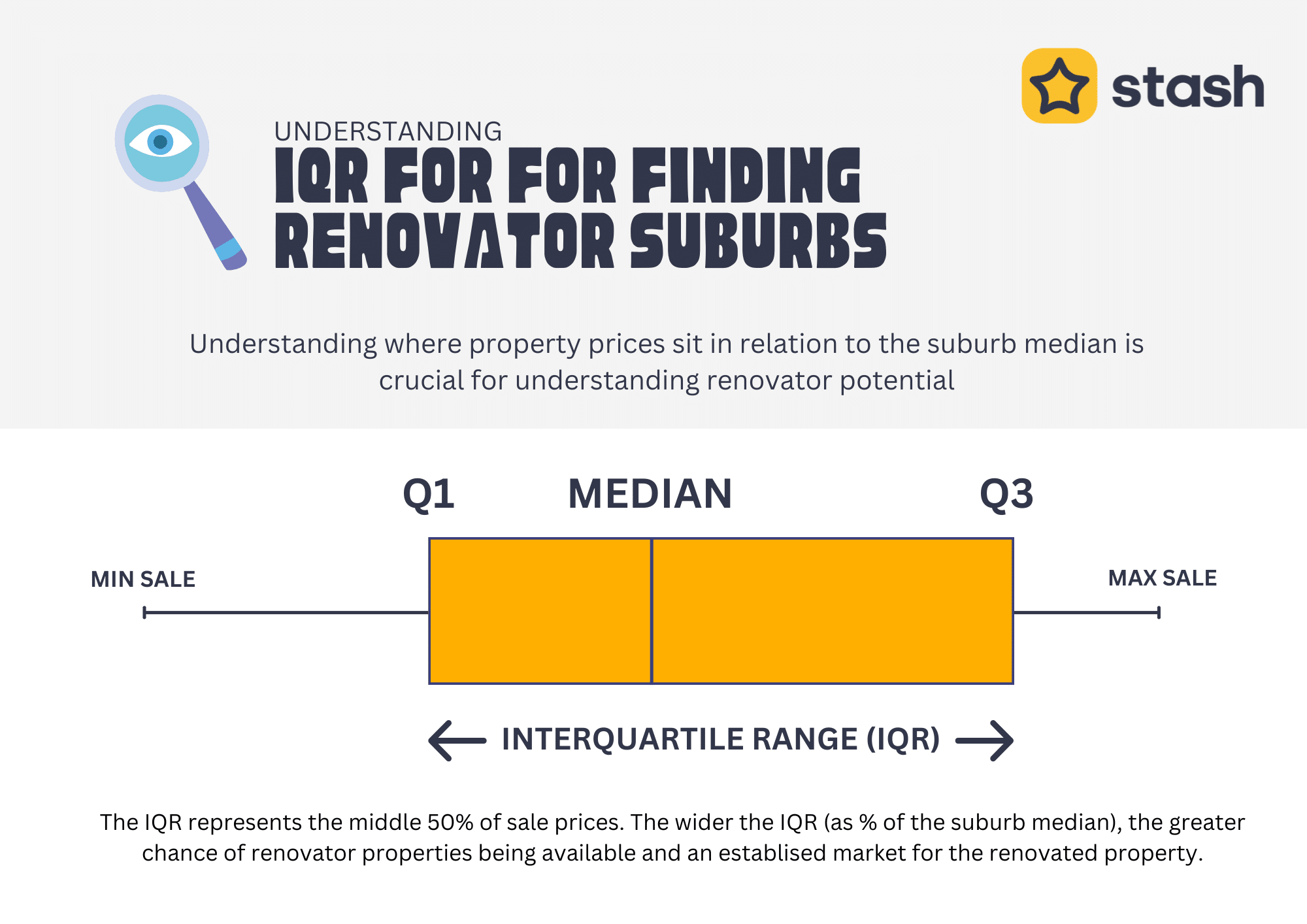
In property market analysis, the Interquartile Range (IQR) represents the spread of the middle 50% of sales prices within a suburb. Essentially, it measures the gap between the 25th percentile (lower quartile) and the 75th percentile (upper quartile) of property prices. This metric helps to show how varied property prices are in a given market. For example, if there were 100 sales in a suburb, sorted from lowest to highest price, the median is roughly the 50th sale, the 25th percentile (Quartile 1) is the 25th sale and the 75th percentile (Quartile 3) is the 75th sale.
IQR % Median is simply the IQR divided by the median price. Dividing by the median lets you compare a $600k suburb with a $2m suburb on the same scale. For the full definitions, see the Stash data dictionary.
A high IQR relative to the median price suggests a substantial difference between properties that are relatively cheaper (potentially run-down or older) and those at the upper end of the spectrum (which may already be renovated or newer). This variation signals that there are properties with potential for value-add renovations within the same suburb, where bringing a lower-priced property up to the standard of higher-end properties could yield significant profit.
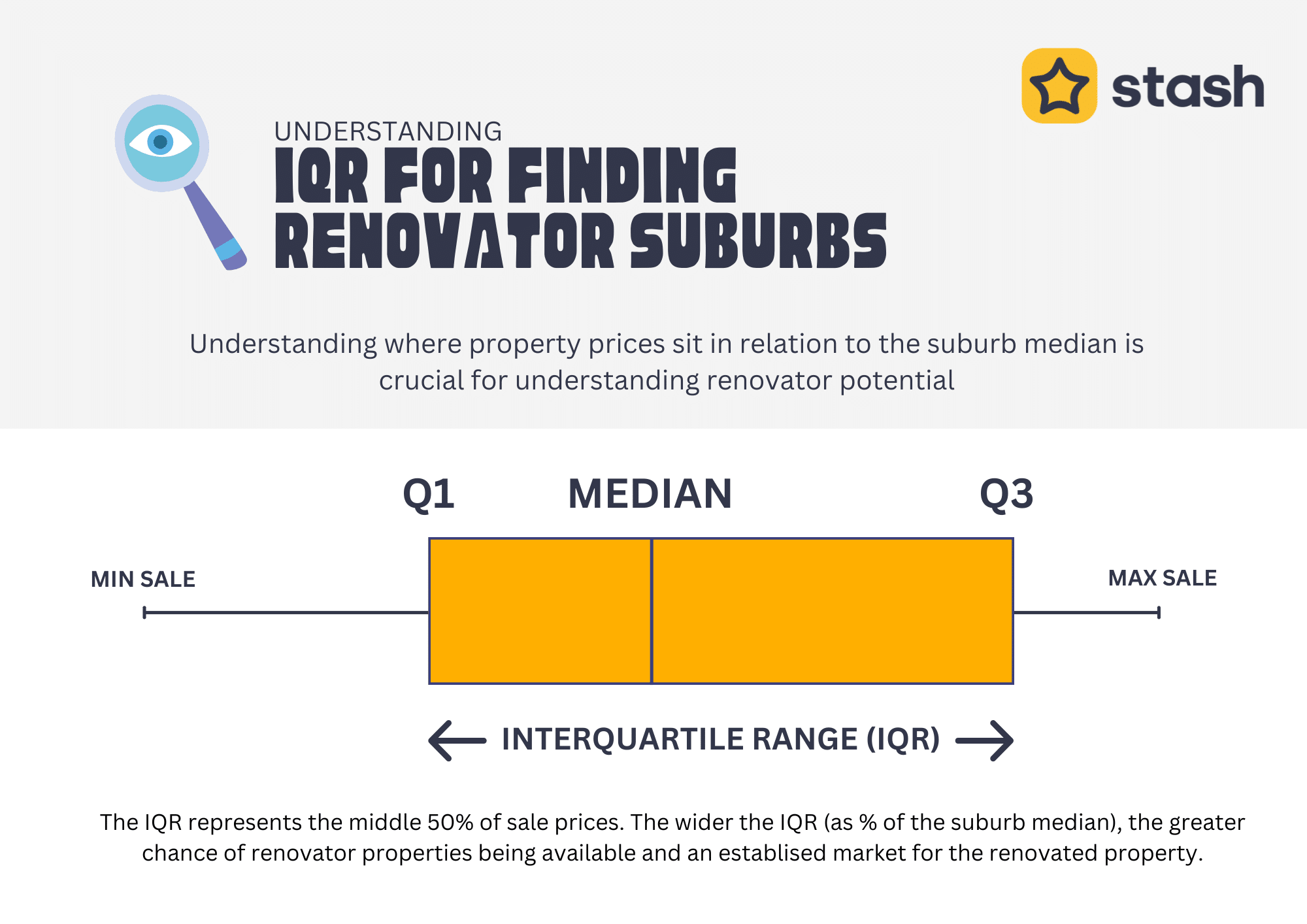
Understanding where property prices sit in relation to the suburb median is crucial for understanding renovator potential
Why High IQR % Median Indicates Renovation Potential
Opportunity for Value Addition
When you see a high IQR % Median, it indicates that the price difference between the lower and upper quartiles is substantial. In simpler terms, there are opportunities for lower-end properties (in terms of pricing) to be improved and potentially moved up closer to the higher quartile of prices. For example, if the IQR in a suburb is 30% or more of the median price, it indicates that the properties at the lower end of the price range could benefit from upgrades to match the pricing of those at the higher end.
Diverse Property Stock
A large spread in property prices often points to diverse housing stock within a suburb. This diversity can stem from factors like a mix of older houses, unrenovated properties, and recently updated homes. Suburbs with such a mix are often in transition and present opportunities to identify properties that can benefit from aesthetic or structural improvements.
Potential for Uplift
The higher the difference between the lower and upper quartiles, the greater the potential uplift for properties in need of renovations. Suburbs with a high IQR % Median often have untapped potential that, when realised, can lead to significant capital growth. Investors who can spot properties in the lower quartile and bring them closer in line with those in the higher quartile stand to benefit from a solid return on investment (ROI).
How to Identify High IQR % Median Suburbs?
Using Stash Property’s platform, you can quickly pinpoint suburbs with high IQR % Median, giving you a competitive edge in identifying renovation opportunities. Here’s how:
1. Open Find Suburbs (Hotspots)
In the Stash side menu, choose Find Suburbs. Pick a State and a Property Type, and add a Median Price range to match your budget. Find Suburbs ranks every suburb against measures such as growth, rental yield, vacancy and IQR. See Hotspots: find investment-ready suburbs.
2. Set the IQR Variance (% Median) slider
Under Investment & Yield, move the IQR Variance (% Median) slider to around 30% to 60%. This indicates that a significant spread exists between lower-priced and higher-priced properties, highlighting renovation potential. Note: some coastal suburbs may falsely indicate renovation potential, because waterfront homes push the upper quartile up. Use the Metro or Regional filter under Location to leave out coastal suburbs if you want to. You can also see the spread across a whole region by turning on the IQR % Median heatmap from Heatmaps on the map.
3. Use Find On Market Deals to locate properties below the median
Once you’ve identified promising suburbs, click the magnifying glass on a suburb in your results and choose On Market, or open Find On Market Deals from the side menu. Set List Price below suburb median to 10%, 20% or 30% to focus on properties priced below the suburb median. Under EXPAND LISTING FILTERS, use Days On Market to find listings that have been on the market for extended periods, giving you negotiating leverage. You can also describe what you’re after, such as “original condition”, in What are you looking for? (Search with AI, in beta). See Find on-market deals.
4. Evaluate Renovation and Profit Potential
Finally, evaluate the potential renovation costs versus the uplift in value. Open Comparable Properties on a property and run a Comparable Sold Properties search. The Search Summary shows Quartile 1, the median, Quartile 3 and the IQR for those sales, and ticking Display Flips, Knockdown Rebuilds & Renovators Only shows properties that resold in the period. Compare the current pricing of unrenovated properties with recent sales of renovated homes within the same suburb. This will help you gauge whether the cost of renovations aligns with the projected profit margins. See Advanced comparable sales search.
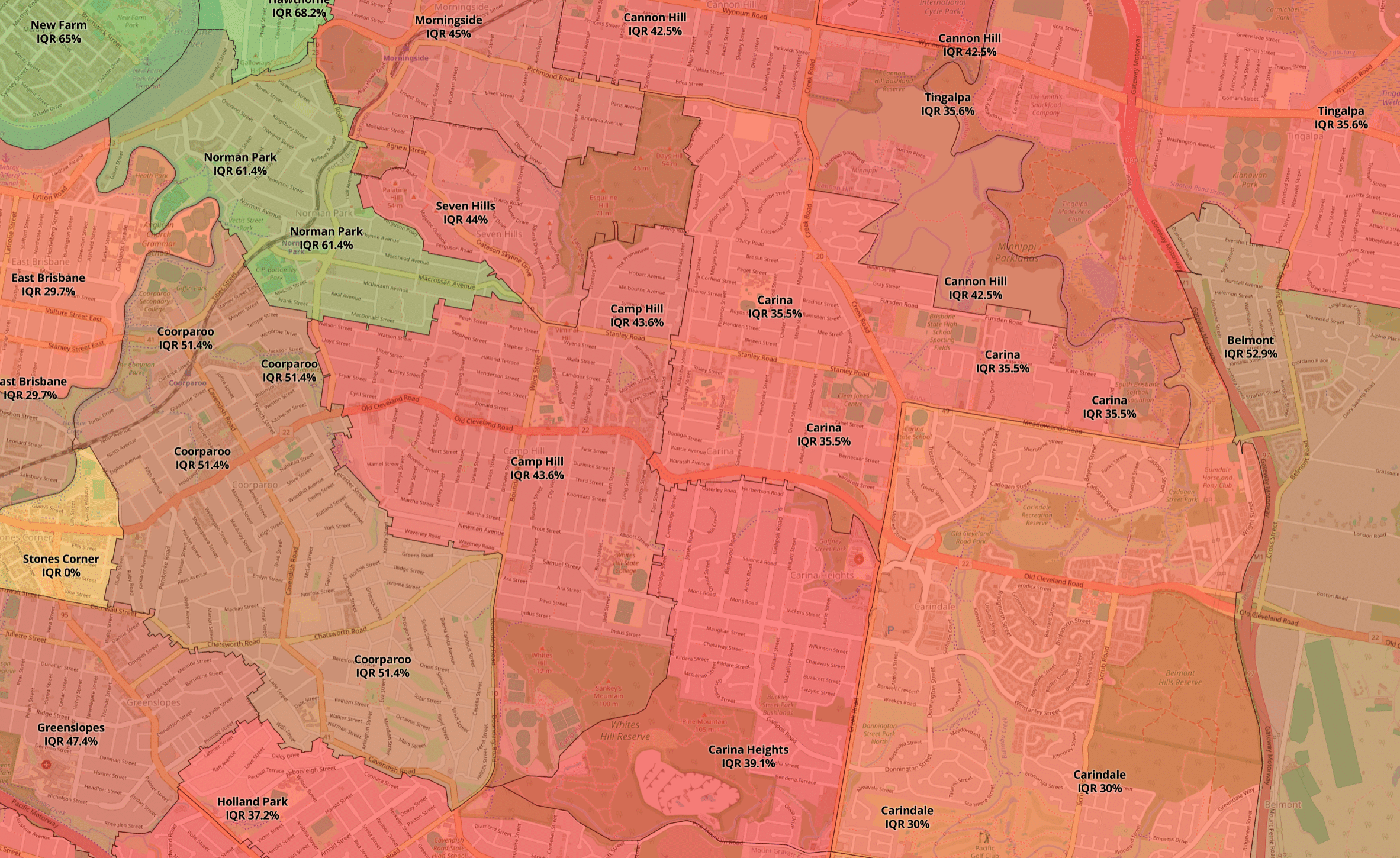
Not every suburb is equal. Save time in identifying suburbs with renovation potential with Stash Property.
Example One: Camp Hill, Qld 4152
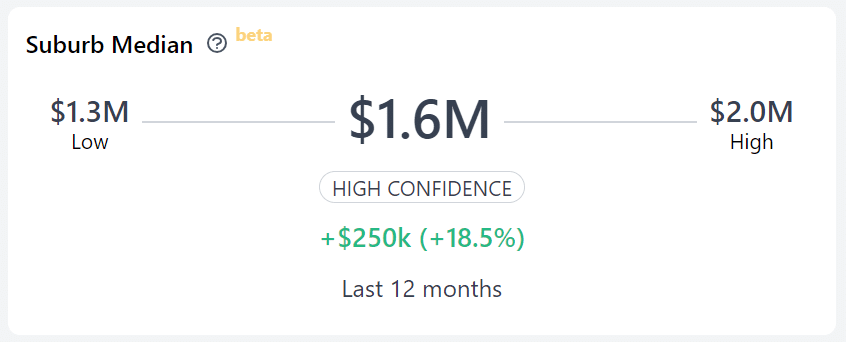
In October 2024, Camp Hill had a median price of $1.6m with a low range of $1.31m and a high range of $2m. The IQR was $696k, which represented 44% of the suburb median. The goal for renovators is to seek properties at the lower end, renovate and sell at the higher end.
October 2026 update: over the 12 months from October 2025, Camp Hill house sales had a median of $2m, a lower quartile of $1.545m and an upper quartile of $2.685m. The IQR is now $1.14m, or 57% of the median, so the spread has widened.
Example Two: Yarrabilba, Qld 4207
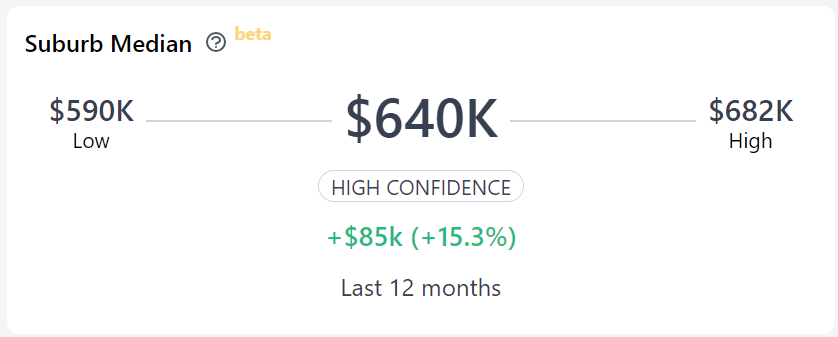
In October 2024, Yarrabilba had a median price of $640k with a low range of $590k and a high range of $682k. The IQR was about 15% of the suburb median. This suburb is likely not suitable for renovation as most houses sold are similarly priced.
October 2026 update: over the 12 months from October 2025, Yarrabilba house sales had a median of $850k, a lower quartile of $808k and an upper quartile of $920k. The IQR is $112k, or about 13% of the median, so it is still a tight, mostly new-build market.
Finding renovation opportunities can significantly boost your returns, but it requires understanding the nuances of property data. A high IQR % Median is a key indicator of diverse property stock and suggests that opportunities exist to add value through strategic renovations.
A high IQR is a starting point, not a guarantee. Small suburbs with few sales can swing a lot, so check how many sales sit behind the figure, then inspect individual properties before you commit.
With Stash Property’s tools and insights, you can confidently identify and act on these opportunities. Use Find Suburbs, Find On Market Deals, Comparable Properties and the Property Timeline tab (for a property’s sales history) to navigate the market with precision. For a step-by-step walkthrough, read Finding renovator properties with Stash.