


Updated November 2026: we’ve added a guide to the residential zone codes used in each state, including WA’s R-Codes (current edition April 2026), and updated the steps to match the current Stash app.
What is the easiest way to locate the Residential Zoning on a property in Australia?
Stash has figured this out for you.
One of the simplest ways is to type in the property address and Stash will provide the Zoning information. Open the property and go to the Planning Insights tab: the Planning & Development Potential card shows the council’s zone code and description, plus lot requirements where council publishes them.
Alternatively, you can use our mapping research tool. Click Layers on the right of the map and switch on the Zoning overlay. Then scroll anywhere in the country and you can see the zoning displayed in a bird’s-eye view. The Zoning Legend button at the top right of the map explains the colours. See View zoning on the map.
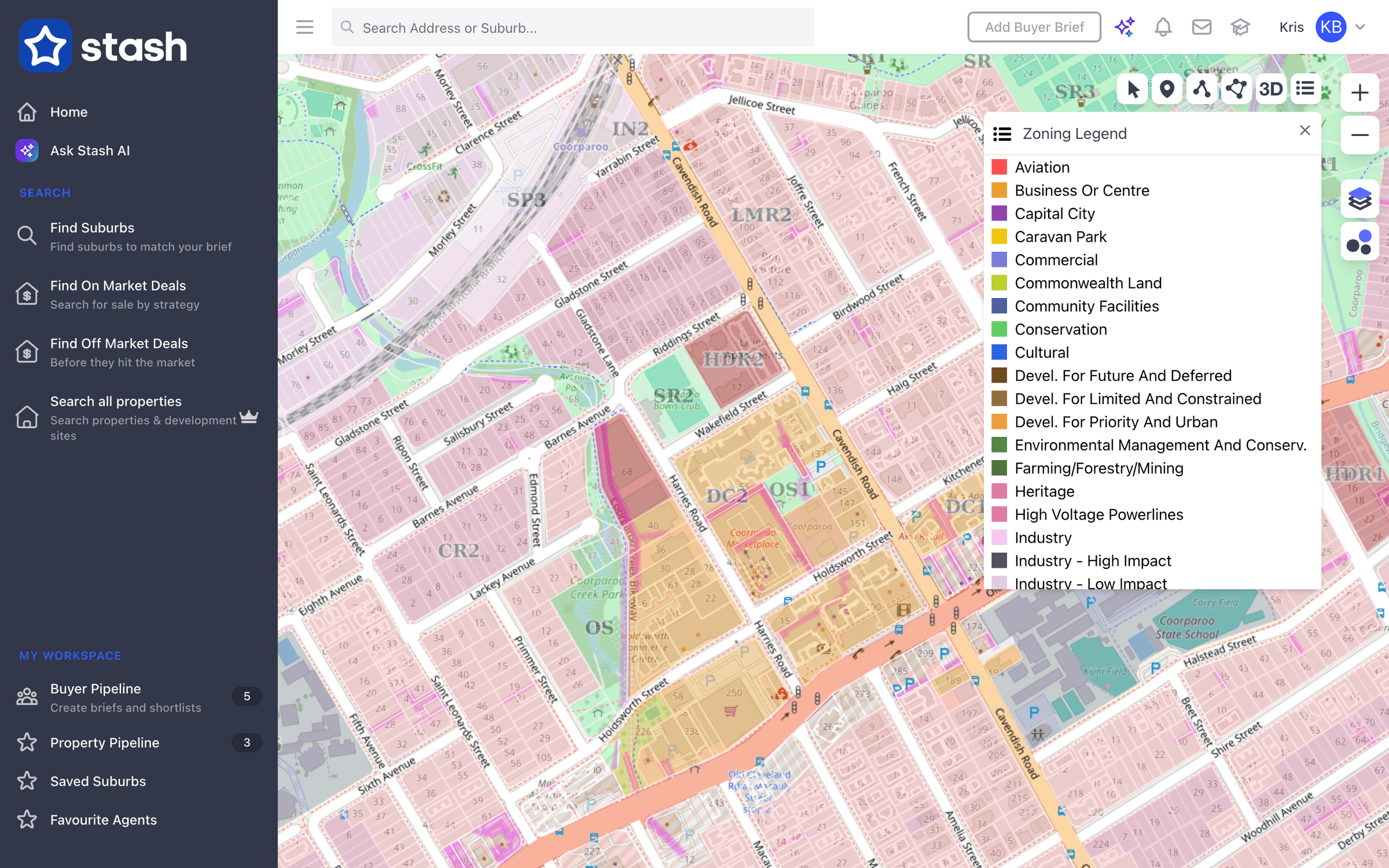
To find out more about any property, just click on the live map, and it will take you straight to the property information.
Stash is making it simple for property investors to locate, research and save property information.
Residential zone codes by state
Each state names its residential zones differently. These are the zones you’ll see most often:
- New South Wales: councils use the zones in the Standard Instrument for local environmental plans (LEPs). R1 General Residential, R2 Low Density Residential, R3 Medium Density Residential, R4 High Density Residential and R5 Large Lot Residential. Each council’s LEP sets what can be built in each zone. Check a property on the NSW Planning Portal spatial viewer.
- Victoria: the main residential zones are the Neighbourhood Residential Zone (NRZ), General Residential Zone (GRZ), Residential Growth Zone (RGZ), Mixed Use Zone, Township Zone and Low Density Residential Zone. Since 2025 the state has also introduced the Housing Choice and Transport Zone around selected activity centres. See the state’s practice note on using the residential zones.
- Queensland: each council writes its own planning scheme. Brisbane City Plan 2014, for example, has Low density, Low-medium density, Medium density and High density residential zones, plus Character residential. Brisbane changed its Low-medium density residential zone from 18 September 2026. Our Queensland town planner interview covers these zones.
- Western Australia: residential land is given a density code under the Residential Design Codes (R-Codes). The higher the number, the smaller the site area per dwelling. Under R-Codes Volume 1 (April 2026), single houses and grouped dwellings need an average of 450m² per dwelling (minimum 350m²) at R20, 220m² (minimum 180m²) at R40, and 150m² (minimum 120m²) at R60.
- Other states and territories: South Australia, Tasmania, the ACT and the Northern Territory each use a single state or territory planning code or scheme with its own residential zone names. Check the relevant planning portal.
For the zone codes used in each state and what they allow, see Australian council zoning codes broken down by state. Zoning rules change, so always confirm a property’s current zone and controls with council or a town planner before you buy or build.
Want a list of every property in a zone? In Search all properties (Find Prospects for real estate and property services accounts), use the Property Zoning filter. See Find off-market properties.
Try our zoning overlays and reverse search with a Stash free trial today.