

"Nobody reads mail anymore." The Australian data says otherwise. Here's what the research shows and why letters suit a high-ticket solar decision.
"Letters don't work. Nobody reads their mail."
If you've said that, you're not alone. Most installers have been burned by a letterbox drop that produced nothing measurable. But the problem usually wasn't the letterbox. It was an unaddressed flyer, sent to everyone, with no way to track who responded.
An addressed, personalised letter is a different channel. Here's what the evidence says.
Australians read addressed mail, and remember it
Research by Accenture for Australia Post found:
- 81% of people are more likely to read and retain information sent by mail, compared with 63% for email.
- 52% said mail shows the sender takes the information seriously.
- 58% said they were likely to purchase or follow up on an offer made to them by mail, and 43% had made a purchase or taken an action as a direct result of mail.
- 56% of 18 to 35 year olds said they trust mail, more than older groups did.
That last point matters for solar. Younger homeowners and first-home buyers are now a large share of the market, and they're the group most tired of sponsored posts.
Why a letter suits a solar decision specifically
Solar and batteries are a considered purchase. Homeowners compare quotes, talk to their partner, check finance and read up on rebates. That process takes weeks.
- A letter stays in the house. It sits on the bench while the decision is made. A feed ad is gone in a scroll.
- A letter can carry detail. Rebate eligibility, battery sizing, finance options and a personalised next step all fit on a page.
- A letter signals legitimacy. In a category where homeowners are wary of cold calls and too-good-to-be-true online offers, an addressed letter from a local accredited installer earns more trust.
The market is moving, and fast
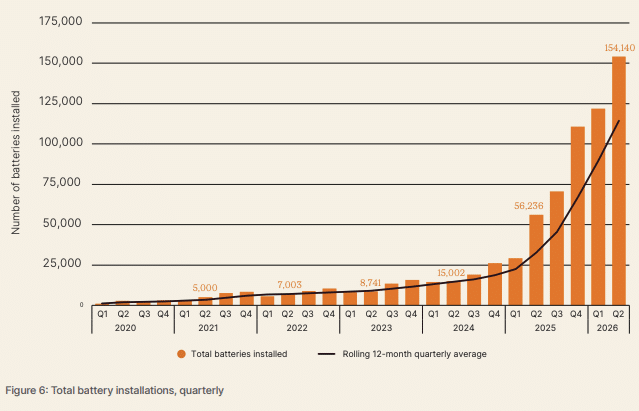
This isn't a shrinking category. The Clean Energy Council's Rooftop Solar and Storage Report (Jan–Jun 2026) recorded 180,878 rooftop solar systems and 276,011 home batteries installed in the first half of 2026, with 153 batteries for every 100 solar installs. Homeowners are actively in market. The question is which installer reaches them first.
So why do some installers say mail failed?
Usually one of four reasons:
- Unaddressed flyers, not personalised letters.
- The wrong list: renters, apartments or homes that already have solar.
- One drop, then nothing. Homeowners rarely act on the first touch.
- No tracking, so real responses were never attributed back to the mail.
Each of these is fixable. None of them is evidence that mail doesn't work.
How Stash Direct Mail fixes all four, done for you
| Why mail "failed" | What Stash Direct Mail does instead |
|---|---|
| Unaddressed flyers | We send your own letter, personalised and addressed to each homeowner |
| The wrong list | We generate the database: homeowners only (no tenants), houses only (no apartments), no solar for system sales or existing solar for battery sales. Or you can use your own prospect list |
| One drop at the wrong moment | We time it: new movers into homes without solar, systems over 10 years old, recently storm-affected areas |
| No tracking | We track every letter with a unique QR code and alert you with the address of every scan |
You provide the letter. We handle the list, the mail-out and the tracking.
What a fair test looks like
If you're sceptical, don't take our word for it. Run a controlled pilot:
- One suburb or postcode cluster, homeowners in houses without solar only (or solar owners, if the test is for batteries).
- Pick a timing segment if you want a sharper test: new movers, 10+ year old systems, or a recently storm-affected area.
- Your letter with one clear offer and one next step, mailed by us.
- A unique QR code per household so every response is attributed.
- Two or three sends over six to eight weeks.
- Judge it on cost per install, not response rate.
The bottom line
Australians still open, read and act on addressed mail. The difference is sending it to the right homeowner at the right moment, and being able to see which homes responded. That's exactly what Stash Direct Mail does for you: a qualified list, your letter in the letterbox, and a QR code on every page.
