

Updated October 2026: we’ve added a plain-English definition of frontage, examples of minimum frontage rules from official sources, and updated the steps to match the current Stash menus.
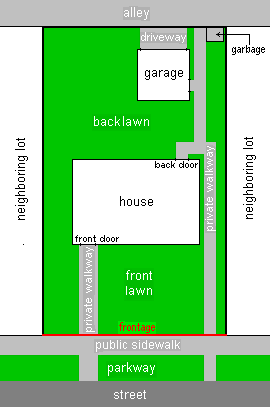
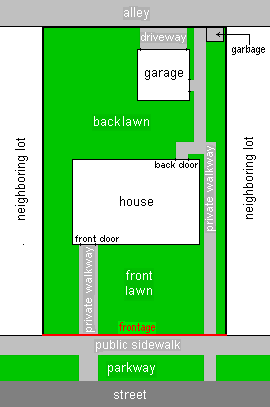
In the real estate world, frontage (also called street frontage, road frontage or lot frontage) is the length of a property’s boundary that runs along the street. On a regular rectangular block, the frontage is the same as the width of the lot at the front. It is the boundary between a plot of land and the road the plot faces.
The term frontage appears on most real estate listings and is considered by most property developers, real estate agents and even home buyers. Councils also use it in their planning rules, so it affects what you can build on a lot and whether it can be subdivided. It is especially important for shops and other commercial and retail property, where a wider frontage means more street exposure.
Types of frontage
- Street or road frontage: the boundary along a public road. This is what most people mean by frontage.
- Lot frontage: the frontage of a single lot on the title. A property that sits across more than one lot can have a different frontage for each lot.
- Building frontage: the width of the front of a building facing the street, rather than the land. It matters most for shops and commercial buildings.
- Corner blocks: have two street frontages, which can give you more options for driveways, access and subdivision.
- Battle-axe lots: sit behind other lots and reach the street only through a narrow access handle, so their frontage is very small.
Why is it important?
- When it comes to real estate, more land usually means more options.
- The width of a lot is an essential factor in determining the value of real estate.
- A wider lot will allow for a larger house and often allow for more space between homes or buildings.
- Wide lots also allow decent parking on front streets or any developments on the lot as long as the zoning permits it.
- Frontage is often included in the planning rules of certain suburbs or LGA; thus, it is one factor that needs to be considered and checked out by property developers, real estate agents, investors, or anyone interested in developing a property.
Examples of minimum frontage rules
Many planning schemes set a minimum frontage or lot width. A few examples from official sources:
- NSW: to build a new house as complying development under the Housing Code, the lot must be at least 6m wide at the building line and at least 200 m² in area (NSW Planning Portal).
- WA: the Residential Design Codes set a minimum frontage for single houses that depends on the density code, for example 10m in areas coded R20 and 12m in areas coded R15 (R-Codes Volume 1, Table D).
- Everywhere else: minimum frontage is usually set in the council’s planning scheme or local planning policies, and it often changes from zone to zone. Always check the current scheme for the site you’re looking at.
There’s a cost associated with frontage, and in some cases, it may be expensive, but just because something is expensive doesn’t necessarily mean it’s desirable.
Frontage is costly for developers, and it can be expensive for homeowners as well. A wider frontage can mean more fencing, footpath and garden to look after. Council rates and land tax are also linked to your property’s valuation, and frontage is one of the things that can lift that value. Be aware that this extra real estate perk does not come for free.
Regardless of the costs, we can conclude that there are more advantages than disadvantages in having larger frontage in a property. Do consider frontage when searching for a home or a property you wish to develop. It’s not possible to get a wider lot all the time since it varies by area and suburb – but when you’re looking where wider frontage is possible, think about the benefits and whether you would value them over the drawbacks. Other things can be changed; the home can be renovated, landscaping can be upgraded, but the frontage is forever.
Due to the popular demand of our Stash subscribers, we added frontage to Stash, and it’s now part of the property search, the property page and your Property Pipeline.
With Stash, you can find great deals and narrow your search down by suburb, zoning, land area and frontage.
Frontage in Stash can also help you to:
- look at the longest frontage first, by sorting your pipeline by Frontage Largest,
- take into account corner blocks and dual access properties, which can give you more usable frontage,
- filter by frontage on previously stashed properties.
How to check Street Frontage inside Stash?
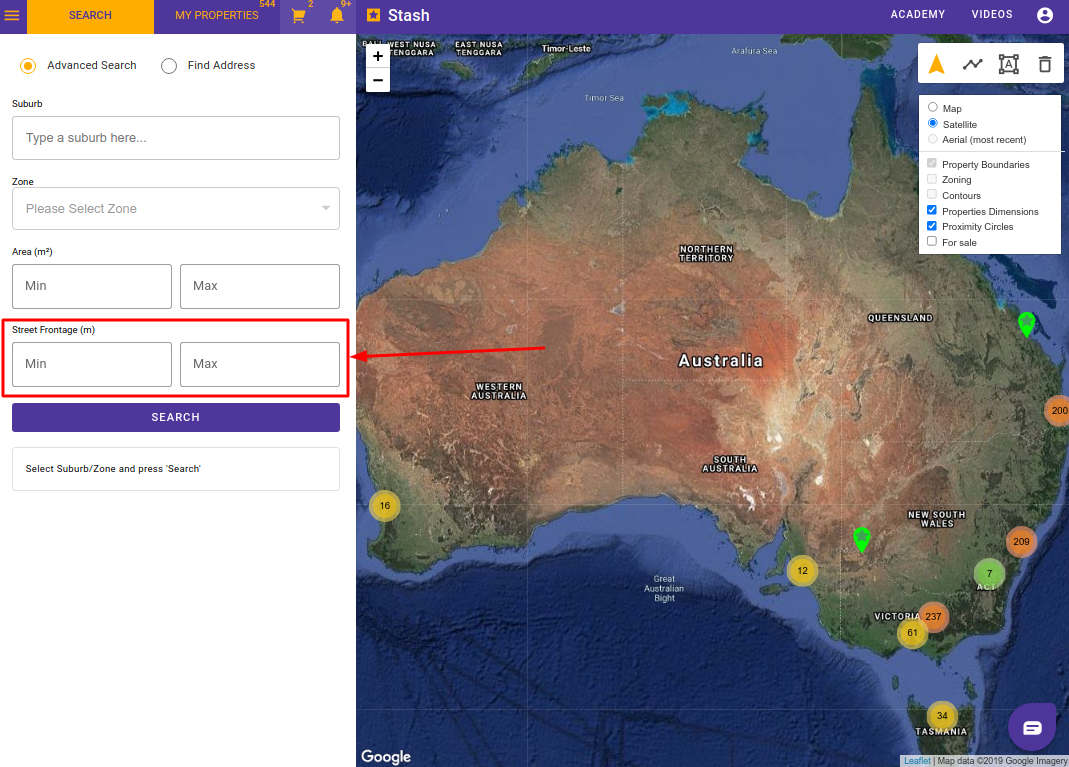

The screenshots in this post are from an earlier version of Stash. The steps below match the current menus.
To see the frontage of a single property, open it in Stash. Its Frontage shows with the other property details at the top of the property page, and in the Planning & Development Potential card on the Planning Insights tab, alongside the council’s Minimum Frontage where it’s available.
To search for properties by frontage, just simply follow these steps:
Street Frontage in Search all properties
- In the side menu, click Search all properties (Find Prospects for real estate and property services accounts).
- Fill in the suburb, postcode or council, then choose your Property Zoning and AREA (m²). Enter a Min, a Max or both under STREET FRONTAGE (m), then click SEARCH. To find corner blocks or dual access properties, click EXPAND LAND FILTERS first.
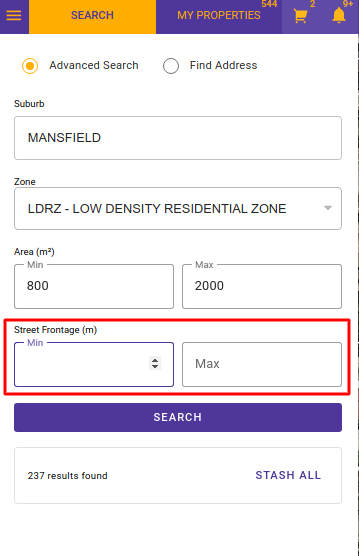
- Once you have the results, hover over or click any property to check its address, land area, frontage and zoning. Switch to Table view to compare frontage across the results.
Street Frontage in your Property Pipeline filters
- In the side menu, click Property Pipeline, then click More Filters (in earlier versions of Stash this was the filter icon
).
- In the More Filters window, find Frontage (m).
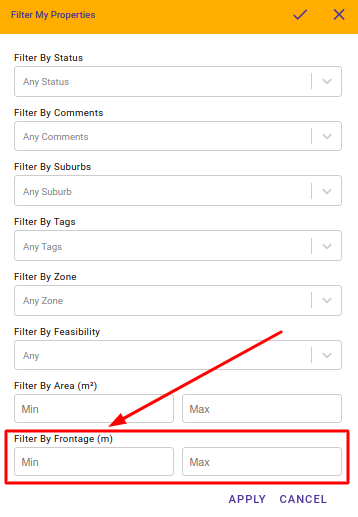
- Enter a minimum, maximum or both and click Done. Only the saved properties in that frontage range will show, in the list and on the map.
For more detail, see our help articles Check street frontage and Filter and track saved properties.
Note: the frontage figure in Stash is a guide only. Corner blocks and irregular lots may be measured differently by council, so confirm with a surveyor before you rely on it. If frontage is missing for a property, you can measure the boundary yourself with the measure distance tool.
Isn’t it that simple and easy to access? All users can follow this through right away, even those who are not tech-savvy. Searching by frontage is included with an active Stash subscription or free trial.
So what are you waiting for? Give it a go, or see plans and pricing.