


Updated November 2026: Queensland’s Planning Act 2016 calls the middle category “assessable” development, so we’ve corrected the terms below and added a quick answer. We’ve also added editor’s notes on prohibited development, public notification and Brisbane’s September 2026 Low-medium density residential changes.
The follow on from the first edition of our Town Planner interview series.
Here we explore the different development types with Queensland Town Planner Jessica Reynolds.
Did you catch Part 1? If not, check it out first to learn about different area zones.
Quick answer: the three categories of development in Queensland
Under section 44 of the Planning Act 2016, all development in Queensland is one of three categories:
- Accepted development: no development approval is needed. You may still need building or plumbing approval, and some accepted development has to meet requirements set in the planning scheme.
- Assessable development: a development approval is needed. It is either code assessable (assessed only against the set codes and benchmarks) or impact assessable (assessed against those benchmarks and other relevant matters, with public notification).
- Prohibited development: a development application can’t be made for it.
Your council’s planning scheme sets which category applies to each type of development in each zone, in its tables of assessment. Jessica explains each one in more detail below.
Understanding different types of development
In Queensland, there are three categories of development; accepted, assessable and prohibited.
- Accepted Development
- Generally applies to development applications (DA) that comply with the local councils building regulations and should therefore be a fairly straightforward application and will not require the assistance of a Town Planner.
- For example, a new office fit-out, which may just require building approval if applicable.
Editor’s note (November 2026): accepted development doesn’t need a development approval, so there’s no DA to lodge. Check the planning scheme for any requirements it must meet, and whether building approval is needed. One recent example: from 18 September 2026, Brisbane City Council made dual occupancies accepted development in the new combined precinct of the Low-medium density residential zone. See the editor’s notes in Part 1.
- Assessable Development
- An application that requires further assessment
- Is the most common type of development assistance a Town Planner will provide.
- Two types of Assessable Development; Code Assessable Development and Impact Assessable Development.
Code Assessable Development
- Typically applies to developments that meet certain codes, however still require further assessment.
- For example one into two lot – subdivision that has a compliant site area, compliant site frontage and low if any environmental impacts.
- Development is envisaged for that site and will likely be approved after the codes are assessed for compliance.
Impact Assessable Development
- Applications triggered as an impact assessable development by the local council, generally means your development is deemed as risky and less compliant to the type of development that was envisaged for that site.
- A public notification process will need to take place to provide an opportunity for neighbours and those in that area to understand the development and pose questions.
- Town Planners are most commonly used for this type of development.
Editor’s note (November 2026): public notification is a legal requirement for any application that needs impact assessment (section 53 of the Planning Act). For the minimum notification period and the other statutory timeframes, see How long it takes to get development approval in Queensland.
- Prohibited Development
- Involves seeking approval for a type of development that does not comply with the typical regulations of the area zone.
- For example, seeking approval for a large commercial development within a low or medium density residential zone.
- These types are of development applications are uncommon, however, a topic in which you could seek advice from a Town Planner.
Editor’s note (November 2026): under section 50 of the Planning Act, a development application can’t be made for prohibited development, so there’s no approval to seek. In most planning schemes, a use that doesn’t suit the zone, such as a large commercial building in a residential zone, is impact assessable rather than prohibited. Check the tables of assessment for your zone, and talk to a town planner if a proposal looks prohibited.
How to check a property’s zone and nearby applications in Stash
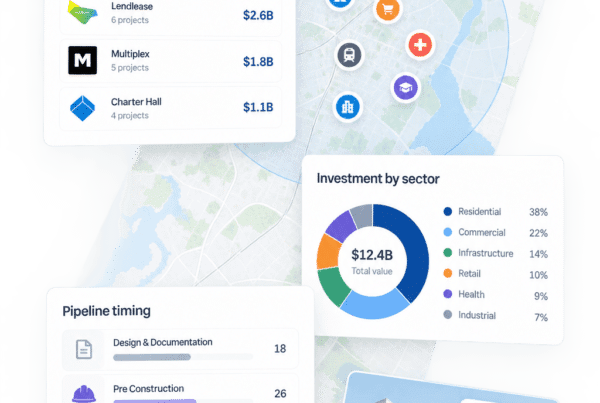
Open any property in Stash and go to the Planning Insights tab. The Planning & Development Potential card shows the council zone and lot requirements, with References links to the planning scheme, so you can look up the tables of assessment for that zone. The Development Applications card on the same tab shows applications lodged for the property and nearby. Click View development applications to open Development Activity and see what kinds of development council has been assessing in the area. See Minimum lot size and zoning details and View recent development applications.
This interview is general information, not planning or legal advice. Planning schemes change, so confirm the category of development with council or a town planner before you buy or lodge an application.
Still, have questions surrounding development types or other Town Planning queries?
Reach out to our support team, we’re here to help you.
Email support@stashproperty.com.au or connect via our live chat now stashproperty.com.au.
Need a town planner’s advice?
For any town planner’s advice in QLD, please contact Jessica from Urban Planners QLD at (07) 3106 3221. You may also send your inquiries to plan@upqld.com.au.
For more information, please visit their website at upqld.com.au.
Are you following us?
Stay connected via our social channels and a monthly newsletter to see our follow on articles as part of our Town Planning series, where we bring you insights from Town Planners across Australia.
Happy Stashing!
Stash Property Facebook Stash Property LinkedIn Stash Property Twitter
Related Blogs
Queensland Town Planner Interview Part 1: Understanding area zones
How long it takes to get development approval in Queensland?