

Updated October 2026: NSW’s low and mid-rise housing reforms, in force since 28 February 2025, set state-wide height and floor space ratio standards for some types of housing that can override council controls. We’ve added the details below and updated the steps to find these controls in Stash.
We’ve listened to your subscriber feedback and understand you really want to be able to access more detailed specifications on existing properties, to assist your future development planning.
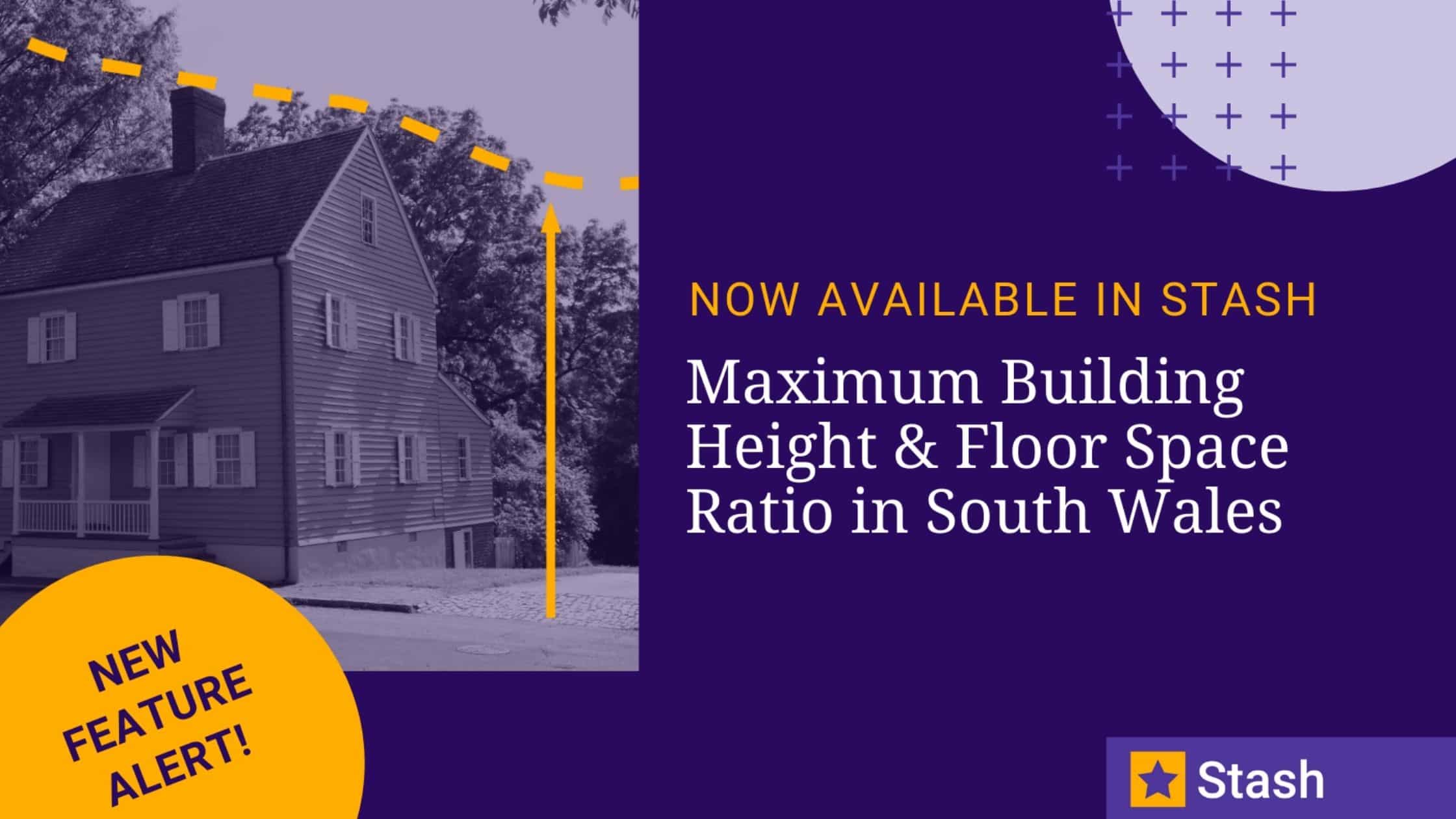
Stash subscribers can quickly and easily view the maximum building height and floor space ratio for NSW properties, taken from each council’s Local Environmental Plan (LEP).
There are so many factors to be considered when exploring future development. Certain limitations or maximums are set by the local council or by state planning rules, depending on where the property is located, and finding these requirements can be difficult. Not every state or council publishes these controls in the same way.
In NSW, councils map height and floor space ratio controls in their LEP, and Stash shows these figures wherever they are in the planning data. If a figure shows as N/A, it isn’t in the planning data for that property, so check the council’s LEP directly.
What do building height and floor space ratio mean for a property developer in NSW?
The principal development standards control the size and form of development.
Building Height:
- More info on how tall your building will be and should be;
- Greater understanding on the basis of the building height;
- Knowing some exceptions that may override the development standards set by the local council; and
- Other factors to be considered along with it.
Floor Space ratio:
- Gives a better picture on how the development will look like
- Knowing the site area
- Knowing the allowable floor space ratio for the site, which is shown on the Floor Space Ratio Map in the council’s LEP. You can look up the planning controls for any NSW site on the NSW Planning Portal Spatial Viewer
- Understanding the gross floor area of the development (this is defined in the Dictionary of each council’s LEP)
Note: It should be noted that gross floor area generally excludes the car parking needed to meet the council’s requirements, including access to that parking.
Development Standards set by the council for the Maximum Building Height and Floor Space Ratio
Maximum Building Height under the NSW Housing Code
Under the NSW Housing Code, the fast-track complying development pathway for new houses and additions, the maximum allowable building height is 8.5 metres. The Housing Code only applies in zones R1, R2, R3, R4 and RU5 (NSW Planning Portal). A uniform approach to building height is applied within the Housing Code to provide clarity and consistency for houses.
The height of a dwelling house is measured from the existing ground level, which is the ground level of a site at any point, before any earthworks (excavation or fill) have taken place.
The maximum height limit of a building may be varied in some circumstances. Development that includes an architectural roof feature that exceeds, or causes a building to exceed, the height limits set by the local council may only be carried out with development consent.
If you lodge a development application instead, it is assessed against the council’s LEP. In most LEPs, clause 4.3 sets the maximum height shown on the Height of Buildings Map, and clause 4.4 sets the maximum floor space ratio shown on the Floor Space Ratio Map. These can be higher or lower than 8.5 metres, depending on the zone and location.
Example: Maximum height of building 8.5m

As for the floor space ratio, it is the ratio of the gross floor area of a development to the site area expressed as a factor of 1. That is, the total floor area on all levels of the building minus any exclusions provided for in the definition of gross floor area, divided by the site area. Floor Space Ratio can be a difficult concept to visualise. For example, an FSR of 0.5:1 on a 600 m² site allows up to 300 m² of gross floor area.
It is often used as one of the regulations in city planning along with the building-to-land ratio. This can also be used in zoning to limit urban density. While it directly limits building density, indirectly it also limits the number of people that a building can hold, without controlling a building’s external shape.
Both heights of buildings and floor space ratios are ‘development standards’ that can be varied under Clause 4.6 Exceptions to Development Standards. The applicant has to justify the variation in a written request, and the clause 4.6 rules were updated for development applications lodged from 1 November 2023 (NSW Department of Planning).
The combination of standards like height, FSR and setbacks, combined with your site’s physical features will determine how big your house can be and where it will be located on your block.
Low and mid-rise housing reforms
Since 1 July 2024, dual occupancies have been permitted with consent in R2 Low Density Residential zones across NSW. Since 28 February 2025, new controls also apply to townhouses, terraces, low-rise apartments and shop-top housing in residential zones within 800 metres walking distance of nominated town centres and train, metro or light rail stations. Under these reforms, the state sets “non-refusal” standards. If a proposal meets them, council can’t refuse it on those grounds, even where the LEP or DCP control is stricter.
- Dual occupancies: maximum FSR 0.65:1, maximum height 9.5m, minimum lot size 450 m².
- Multi-dwelling housing: maximum FSR 0.7:1, maximum height 9.5m, minimum lot size 600 m² (500 m² for terraces).
- Residential flat buildings in R3 and R4 zones: up to 2.2:1 FSR and 22m within 400 metres of the station or centre, and up to 1.5:1 FSR and 17.5m between 400 and 800 metres.
Exclusions apply, for example on some flood and bushfire prone land, so check the NSW low and mid-rise housing policy and the council’s maps before relying on these figures for a site.
How to check out this feature inside Stash?
To view the maximum building height and floor space ratio inside Stash, simply follow the steps below:
- Open your potential target property, by searching for its address or clicking it on the map.
- Be sure to stash the property so you can easily access it again in your Property Pipeline.
- Click the Planning Insights tab. In the Planning & Development Potential card, Building Controls shows the Max Building Storeys, Max Building Height and Building Floor Space Ratio.
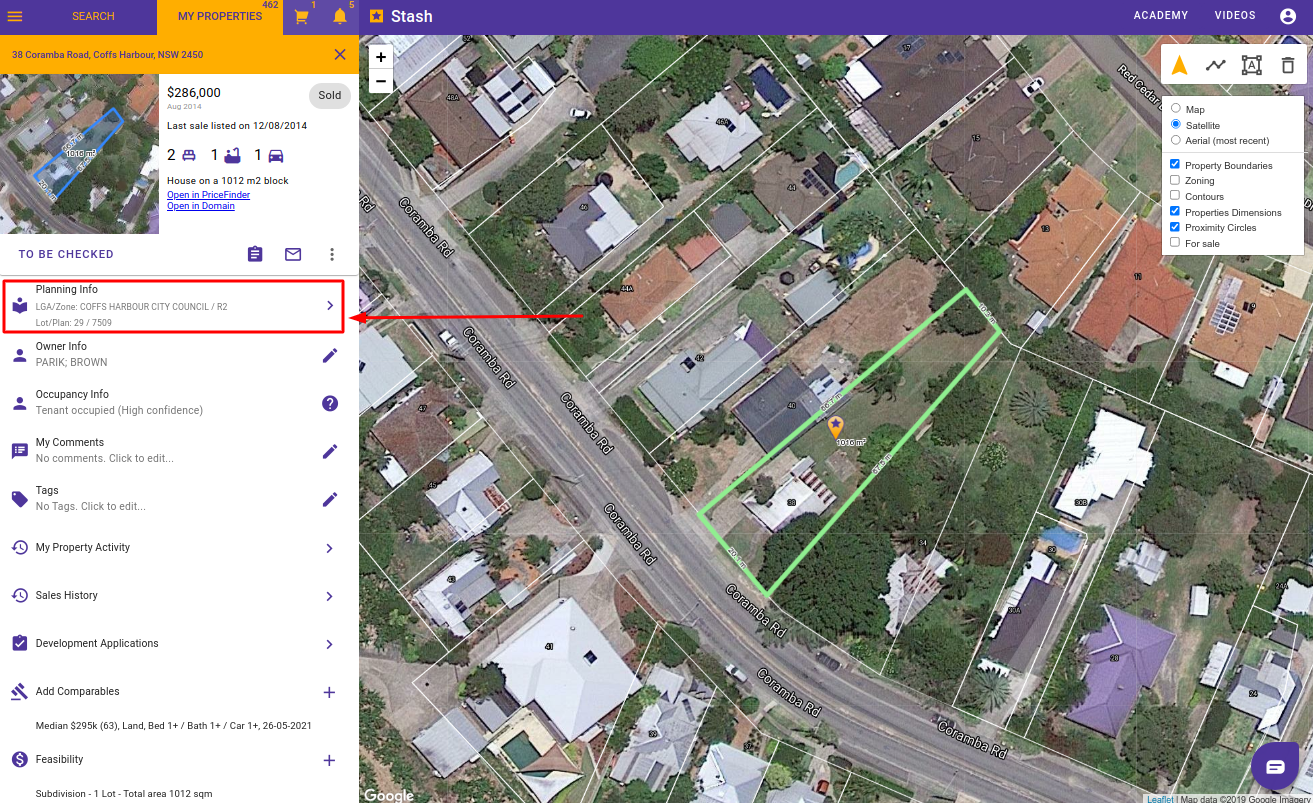
- For the full details, open the Property Details tab and click VIEW PLANNING INFO in the Property Description card. The Planning Info page shows the Building & Height Restrictions for the property. You can also click the links under the References heading to check the source, such as the LEP clauses for height and FSR.
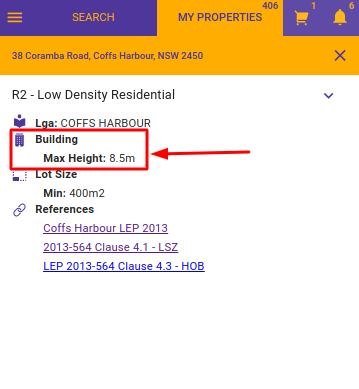
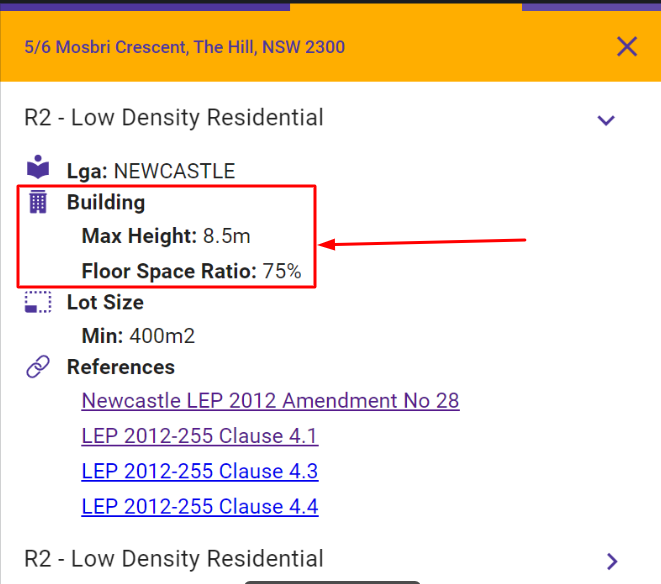
The screenshots above are from an earlier version of Stash. For a full walk-through of every planning field, see Minimum lot size and zoning details.
Well, that information isn’t that hard to find if you have Stash. Go ahead and give it a try! We’d love to hear your feedback on how this works for you.
We’re here to help you.
Please contact us at support@stashproperty.com.au.
Happy Stashing!
Disclaimer: The information provided by Stash Property is for general informational purposes only. All information on the site is provided in good faith, however, we make no representation or warranty of any kind, express or implied, regarding the accuracy, adequacy, validity, reliability, availability or completeness of any information on the site. Under no circumstance shall we have any liability to you for any loss or damage of any kind incurred as a result of the use of the site or reliance on any information provided on the site. Your use of the site and your reliance on any information on the site is solely at your own risk. It is still advised that users should do their own due diligence.